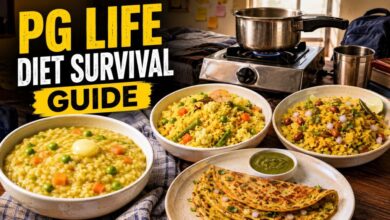
7-Day Budget Indian Meal Plan Under ₹5,000: Stop Letting Swiggy Plan Your Life
There’s a moment mid-month when you open your banking app and realise your biggest expense is not rent. It’s paneer tikka and “quick bites” that were supposed to be cheap.
This site is about Ayurvedic-ish, realistic food for 18–35-year-olds who have jobs, a brain, and maybe some guilt. You’re working full-time, you want energy and decent health, but you also live in a city where two “healthy” bowls equal half your monthly grocery budget. Meanwhile, people managing their food carefully report cooking for one in roughly ₹4,000–₹5,000 on groceries and spending a similar amount on eating out by choice, not by chaos.
So here’s the plan: one human-doable 7-day Indian meal pattern that loops across the month, built from a basic grocery list that stays under ₹5,000 for one person if you mostly cook at home. You’ll get normal food: roti, sabzi, dal, rice, upma, poha just structured and cost-aware, with a bit of Ayurveda logic on timing so your digestion doesn’t hate you.
THE THING NOBODY ACTUALLY SAYS OUT LOUD
Nobody says this in finance reels: your food problem isn’t only that eating out is expensive it’s that you’re paying restaurant prices to avoid making three extremely simple things on repeat.
Most working people’s weeks look like this:
- Monday: “Fresh start” salad or sabzi-roti box.
- Tuesday: “Meeting ran late” → office canteen.
- Wednesday: “I deserve it” Zomato.
- Thursday: random cereal or toast for dinner because you’re tired.
- Friday: “We’ll see.” (Always ends in something fried.)
Then we pretend a ₹5,000/month budget is impossible, while single folks on Indian forums quietly say they keep groceries for one at or under that if they cook most dinners and at least some lunches. One woman mentions groceries under ₹5,000 for herself plus ~₹3,000 eating out because she cooks one full meal and snacks at home.
Ayurveda has been rolling its eyes forever: it wants regular meal times, your main meal in the middle of the day when digestion (Pitta time) is strongest, and lighter dinners… not biryani at 11:30 pm because Slack pinged late.
But we don’t organise food like that. We organise food like:
- “Whatever is closest to the office.”
- “Whatever is open on the app.”
- “Whatever doesn’t require chopping.”
The unglamorous truth: if you want to eat decently under ₹5,000/month, you basically have to accept three mildly annoying ideas:
- You’ll eat a rotation, not a variety show.
- You’ll batch cook boring bases (dal, rice, basic sabzi) once or twice a week.
- You’ll decide in advance which meals can be “outsourced” (like 2–3 social meals a week) and which must be home food.
The good news is: once you set this up, you spend less time thinking about food, not more. Decision fatigue moves from “what should I order?” to “dal or sambar?” which is honestly an upgrade.
Read Also 7 दिन तक कुछ नहीं खाया तो क्या होगा? (भाई, हालत खराब हो जाएगी! 🥶)
HOW THIS ACTUALLY WORKS THE REAL MECHANICS
Let’s talk structure before recipes. A ₹5,000/month budget for one person works only if you:
- Plan groceries in bulk.
- Repeat 80% of your meals.
- Use Indian staples that stretch: rice, atta, dal, potatoes, onions, seasonal veg.
1. The money side
In many Indian cities, someone cooking most meals for themselves can keep groceries in the ₹4,000–₹6,000 band depending on how much fresh produce, dairy, and branded extras they buy. People who track their food costs for travel and home cooking show that simple Indian meals dal, sabzi, rice, roti are extremely cost-efficient compared to restaurant food.
Roughly, if you:
- Buy staples (rice, atta, dal, basic oils, spices) monthly.
- Buy vegetables and fruit weekly based on what’s cheap.
You can sit around ₹5,000/month if you’re not buying premium snacks every time you shop.
2. The Ayurvedic side
Ayurvedic nutrition guides keep repeating the same hits:
- Regular meals, especially lunch between about 11 am and 1–2 pm when digestion is strongest.
- Lighter dinners before ~7:30–8 pm when possible heavy, late food = more “ama” (undigested gunk).
- Fresh, warm, simply spiced food > cold, stale, packaged stuff.
So our 7-day structure will:
- Make lunch your main proper meal when you can manage it.
- Keep dinner simpler and easier to digest.
- Use spices and ghee/oil in moderation so your digestion can keep up.
3. The niche angle most “meal plan” posts skip
Most plans ignore your actual life. They act like you’re a full-time home cook. You’re not. You’re a working person who:
- Can batch cook 1–2 times a week.
- Can maybe chop some veg once mid-week.
- Needs fast breakfasts and packable lunches.
So our 7-day plan will revolve around:
- One bulk dal pot (Sun).
- One bulk sambar/rasam / or chana/rajma pot (Sun/Wed).
- One batch of dry sabzi that can go into wraps or with rotis.
- Breakfasts that are 10–15 minutes max (poha, upma, oats, eggs, leftover paratha).
Short list with real opinions:
- Rice + dal + one sabzi is not boring; it’s the baseline that keeps you from becoming a full-time Swiggy customer.
- Poha and upma are S-tier weekday breakfasts: cheap, quick, and Ayurvedically nicer than cold cereal.
- Roti-sabzi for dinner is fine if lunch is decent and not just coffee and air.
Read Also Budget & Student Healthy Food Plans
COMPARISON WHAT’S ACTUALLY DIFFERENT BETWEEN YOUR OPTIONS
Core Strategies for a ₹5,000/Month Food Budget
| Option | What it actually does | Who it’s for | The catch |
| Full home-cooked base + 2–3 meals out/week | Groceries ~₹4–5k, predictable simple meals, a few social/“treat” meals outside. | Working pros who can cook 2–3 times a week. | Needs planning and some Sunday discipline. |
| Office canteen + light home cooking | Canteen handles lunch; you do breakfast and dinner at home. | People with cheap office food options. | Canteen quality varies; dinner must be kept light but still nourishing. |
| Mostly ordering in + occasional cooking | Time saved on cooking, taste variety, heavy app spend. | Those prioritising convenience, high stress, no kitchen. | Hard to stay under ₹5,000 total; digestion and health usually suffer. |
My take: base your life on “full home-cooked base + 2–3 meals out,” and if your office canteen is decent, use it as one of those “out” meals instead of random delivery. That’s the only structure that respects both your health and your bank balance.
WHAT ACTUALLY HAPPENS WHEN YOU TRY THIS
When you actually live on a ₹5,000/month home-cooked plan with a 7-day rotation, the first week feels like admin work. After that, it feels like breathing.
You pick a Sunday, put on something trashy in the background, and:
- Cook 1 big pot of dal.
- Cook 1 big pot of something like sambar/rasam or chana/rajma.
- Chop 2–3 vegetables (potato, bhindi, beans, carrot, capsicum) for quick sabzis.
- Make extra dough and parathas for freezing or 2–3 days of rotis.
Your weekday looks more like:
- Breakfast in 10–15 minutes: poha/upma/oats/eggs.
- Lunch: dal + rice/roti + sabzi, carried in a dabba or eaten quickly at home.
- Evening: fruit, nuts, or leftover chana/khichdi as snack.
- Dinner: simple roti-sabzi or soup + khichdi, not full biryani cosplays.
After roughly 10–14 days, most people experience quietly un-sexy things like:
- Fewer dramatic afternoon crashes because your lunch wasn’t just bread and coffee.
- Less acidity and heaviness at night because dinners are smaller and earlier.
- More money sitting in your account because ₹200–₹400 per day of delivery just stopped leaking.
The surprise pattern you only notice once you’re in it: food decision fatigue leaves your brain. You’re no longer thinking “What should I eat?” 12 times a day. You’re just running the plan: today is “Day 3, breakfast X, lunch Y, dinner Z.” You can still swap days when life explodes, but your default is handled.
What almost no generic meal plan article tells you: it’s not the recipes themselves that change your health and budget. It’s the fact that you removed choice from 80% of your food. The less you negotiate with yourself at 8 pm, the less you order nonsense that wrecks both your wallet and your digestion.
THE ADVICE EVERYONE GIVES VS WHAT ACTUALLY WORKS
1. “Just meal prep everything on Sunday”
You are not a fitness influencer with glass containers and a brand deal. Most people who try full Sunday prep go hard for one week, then burn out because eating five-day-old sabzi is depressing.
Reality:
- Cooking bases on Sunday dal, sambar/rajma, par-cooked beans/chana, chopped onions/tomatoes is sustainable.
- Cooking every single item for 7 days ahead usually isn’t, unless you genuinely like reheated food.
2. “Just eat salad for dinner, that’s cheap and light”
Raw salads for dinner are a digestion horror movie for a lot of Indian guts, especially if you’ve been sitting all day and your agni (digestive fire) is low. Ayurvedic nutrition guidance is clear: heavy raw food at the wrong time is harder to digest and can create more “ama.”ayurved.
Alternative:
- Light, warm dinners with khichdi, simple sabzi, or soup + a little rice are far more realistic and gut-friendly… and they still fit a ₹5,000 budget.
3. “I’ll just wing it with groceries, I roughly know what I need”
There’s a reason every adulting blog goes hard on monthly grocery lists: we’re terrible at “roughly.” Indian grocery planners for 1–2 people consistently include: 3–5 kg atta, 3–5 kg rice, 2–3 kg assorted dals, basic oils, onions, potatoes, and 1–2 kg of seasonal veg per week otherwise you end up short and order out.
Better:
- Create a simple 1-person monthly list scaled down from those templates so you always have grains, pulses, and basics at home. Top up veg and fruit weekly based on offers.
4. “Ayurvedic eating is too complicated for office life”
If you read classical guidelines word-for-word, sure. But modern Ayurvedic nutrition guides already offer a compromise: main meal at or before 1–2 pm when you can, lighter dinners before ~8 pm, fresh and warm food more often than packaged or stale.
Adapted version for working pros:
- Make lunch your main carb + dal + sabzi meal whenever possible.
- Keep dinner soup/khichdi/roti-sabzi focused and not super heavy.
- Avoid eating a full meal more than 1–2 hours after sunset when you can help it.
Read Also 30-Day Indian Diet Plan for Weight Loss (No Gym, No Starving)
THE PRACTICAL PART WHAT TO ACTUALLY DO
1. Build a one-person monthly grocery template (~₹5,000 cap)
Scaled down from common Indian lists and budget experiences:
- Grains: 3 kg rice, 3 kg atta.
- Pulses: 1 kg toor, 1 kg moong/masoor, 1 kg chana/rajma mix.
- Oils: 1–1.5 L cooking oil, small ghee.
- Dairy: 1–2 L milk/week, 500 g curd/week.
- Veg: 1–1.5 kg onions, 1–1.5 kg potatoes, 3–4 kg assorted seasonal veg per week.
- Basics: spices, salt, sugar/gur, tea/coffee, a few nuts/seeds/peanuts.
Buy staples once, veg and fruit every week based on what’s cheap and fresh.
2. Lock your 7-day “skeleton” and reuse it all month
Here’s a simple 7-day structure you can rotate:
- Breakfast loop:
- Poha with peanuts + veg
- Upma with veg
- 2 eggs + toast
- Oats with milk + nuts
- Lunch loop:
- Dal + rice + sabzi
- Sambar rice + curd + salad
- Chole/rajma + rice/roti
- Dinner loop:
- Khichdi + ghee + pickle
- Roti + dry sabzi
- Light soup + toast
You’ll match specific dishes in the next steps, but this is your “slots” system.
3. Do a realistic Sunday prep 2 pots + chopping
On Sunday (or any off-day):
- Cook 1 pot of plain dal (toor/masoor/moong mix).
- Cook 1 pot of either sambar, chana, or rajma.
- Chop onions, tomatoes, basic veg in bulk and store.
- Make some dough and par-cook a few rotis or parathas if you like.
These 2 pots + prepped veg carry you through 3–4 days of lunches and at least 2 dinners.
4. Follow this sample 7-day plan (and then repeat)
(I’ll outline types, not exact grams, so you can adjust quantity.)
Day 1 (Mon)
- Breakfast: Veg poha with peanuts.
- Lunch: Toor dal + rice + aloo-bhindi sabzi + salad.
- Dinner: Moong khichdi + ghee + roasted papad.
Day 2 (Tue)
- Breakfast: Upma with mixed veg.
- Lunch: Sambar rice + cucumber-carrot salad + curd.
- Dinner: 2 rotis + dry lauki/beans sabzi.
Day 3 (Wed)
- Breakfast: Oats cooked in milk with nuts and a bit of jaggery.
- Lunch: Rajma + jeera rice + simple kachumber.
- Dinner: Tomato-dal soup + 1–2 small phulkas.
Day 4 (Thu)
- Breakfast: 2 boiled eggs + toast + fruit.
- Lunch: Masoor dal + rice + cabbage/beans sabzi.
- Dinner: Leftover khichdi or light veg pulao.
Day 5 (Fri)
- Breakfast: Leftover upma or poha.
- Lunch: Chole + roti + salad.
- Dinner: Simple veg soup + toast, or roti + sabzi if you’re hungry.
Day 6 (Sat)
- Breakfast: Paratha (aloo or leftover sabzi) + curd.
- Lunch: Sambar + rice + beetroot or carrot poriyal-style.
- Dinner: Roti + paneer bhurji (small portion) + veg.
Day 7 (Sun)
- Breakfast: Idli/dosa (homemade batter or store-bought) + sambar.
- Lunch: Full “nice” thali at home: dal, sabzi, rice, roti, salad, curd.
- Dinner: Light soup, khichdi, or just fruit + milk depending on hunger.
Then you loop this pattern with small swaps based on what veg is cheap this week.
5. Pre-decide your “outside food” quota
Be an adult and decide:
- Two meals a week can be ordered or eaten out (Friday dinner, Sunday lunch, whatever).
- Everything else is home food by default.
If you don’t define this, every bad day becomes “I deserve takeaway,” and your ₹5,000 fantasy dies on week one.
QUESTIONS PEOPLE ACTUALLY ASK
How can I eat under ₹5,000 per month as a working professional?
Stick to a simple rotation of Indian staples: rice, atta, dal, seasonal vegetables, a bit of dairy, and basic snacks like peanuts or chana. Many people who cook at least one proper meal daily report grocery spend in the ₹4,000–₹5,000 band for one person, plus whatever they choose to spend eating out. Plan your grocery list, cook bases once or twice a week, and cap restaurant meals to 2–3 per week instead of defaulting to daily delivery.
Is a 7-day rotating meal plan actually realistic with a full-time job?
Yes, if you keep it simple. Home cooks and planners show that batch-cooking dal, one curry or sambar, and prepping vegetables once a week makes weekday meals much faster. You’re not cooking elaborate dishes every day; you’re recombining the same bases into different plates. The 7-day plan becomes less about fancy recipes and more about “what’s in my two pots and what can I pair with them.”
How do I make this work if my office has a canteen?
Let the canteen handle your main meal ideally lunch, which Ayurveda also sees as the best time for a heavier meal. Then simplify: have quick, light breakfasts (poha, upma, oats, eggs) and light but warm dinners (khichdi, roti-sabzi, soup + toast) at home. You still buy groceries, but mainly for breakfast, dinner, and snacks, which can keep your total food spend closer to that ₹5,000 range if the canteen is reasonably priced.
Can I follow Ayurvedic timing if I work long hours?
Not perfectly, but partially. Ayurvedic nutrition suggests your main meal between roughly 11 am and 1–2 pm and lighter dinners not too late. If your schedule is wild, aim for: a decent breakfast, a proper lunch (home or canteen), and an intentionally lighter dinner before ~8 pm when possible. Even that compromise reduces late-night heaviness and supports better digestion.
What if I hate repeating meals?
Then staying under ₹5,000 will be harder. People who manage low grocery budgets generally eat on a rotation with small tweaks the same dal type but different sabzi, or the same breakfast with different toppings. You can still add variety by changing the masala profile, switching rice for roti, or adding a raita one day and a salad the next, but full novelty daily is expensive and time-heavy.
How do I fit fruit and nuts into a tight budget?
Scale your expectations: you probably won’t have berries and exotic stuff daily. But a basic list with seasonal bananas, guava, papaya or apples plus small packets of peanuts, chana, and some affordable nuts like groundnuts or small almond packs is doable. Many grocery lists allocate modest monthly amounts to peanuts and small quantities of nuts/dry fruits for snacking and nutrient top-ups.
Is it cheaper to cook Indian food at home than to eat out?
Almost always, yes. Budget and travel writers who actually track costs show that home-cooked Indian meals (dal, sabzi, rice, roti) are significantly cheaper per serving than restaurant or delivery food, even in cities. The main cost is your time and planning; once those are in place, groceries stretch much further than app orders.
How do I avoid food waste when cooking for one?
Use a monthly grocery template but buy perishable items in small, frequent amounts for example, vegetables weekly and fruit every few days. Batch-cook items that freeze or hold well (dal, rajma, cooked beans, base sauces) and keep recipes simple so you can repurpose leftovers into wraps, parathas, or pulao instead of throwing them away.
SO WHERE DOES THIS LEAVE YOU
You’re not going to live a perfect Ayurvedic, budget-optimized life while juggling work, commutes, and whatever your boss thinks “quick sync” means. You will have days where dinner is biscuits. You’ll have weeks when the 7-day plan collapses under deadlines. That’s normal.
But this is the gap: if you do nothing, food will keep draining your money and your energy quietly. If you do a bit one grocery list, two bulk-cook sessions a week, and a 7-day rotation you mostly follow you can stay near ₹5,000/month on groceries, have decent digestion, and still say yes to the occasional pizza without panic.
If you do one concrete thing today, don’t rewrite your life. Just: sit down and sketch your own 7-day template based on what you already like plug in a realistic breakfast, lunch, and dinner for each day, using dal-rice-sabzi and poha/upma/eggs as anchors. Then shop once for that week and run the experiment. You can optimise once it survives a normal, messy work week.
You made it to the end of an article that talked more about onions, dal, and timing than “superfoods,” which tells me you’re actually serious about fixing this money-and-food mess. I won’t pretend that staying under ₹5,000 while working full-time is effortless it’s not. It’s a little bit of planning, a little bit of repetition, and a lot of saying no to the lazy part of your brain that wants to outsource every decision to an app.
But if you get your food on autopilot, a funny thing happens: you have more energy and more money to care about other parts of your life. And that’s really what this meal plan is buying you not just lunch, but margin.