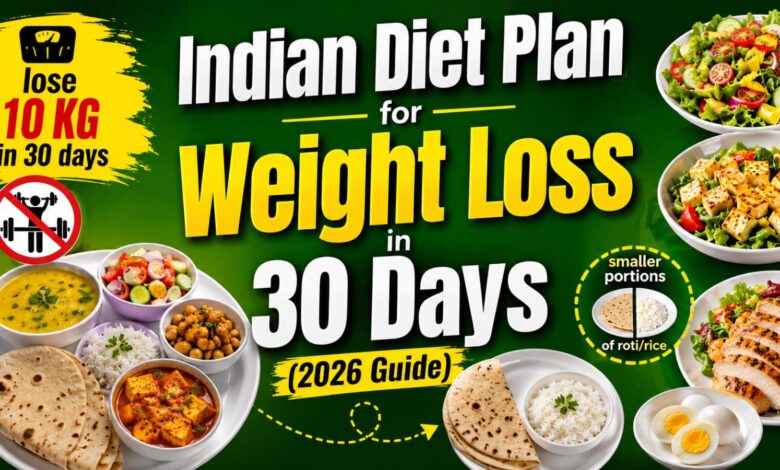
Indian Diet Plan for Weight Loss in 30 Days (Without Gym, Without Going Crazy)
You’re 19, your jeans don’t button, and somehow your parents think the solution is “just eat less and walk in the park.”
Meanwhile, Instagram is yelling “lose 10 kg in 30 days” like your body is a discount sale.
This site is about health, not punishment. Think realistic weight loss, Indian food, home kitchen, and people who don’t have time to live inside a gym. You want to lose weight in 30 days, but you also want to pass exams, hang out, scroll reels, and not faint on the staircase.
Here’s the line nobody usually says: you can lose weight in 30 days on a normal Indian diet, with no gym and no starvation but not the “10 kg in a month” fantasy the internet keeps selling. Most safe plans talk about 2–4 kg per month as a healthy, sustainable rate, and they didn’t make that up; it’s based on what major health bodies recommend globally.
So this isn’t a magic plan. It’s a grown-up one. Slightly annoying, actually. But it works, and it respects the fact that you’re a human, not a “before/after” thumbnail.
THE THING NOBODY ACTUALLY SAYS OUT LOUD
Let’s start with the blunt bit: most “Indian diet plan: lose 10 kg in 30 days” content is either unrealistic, unsafe, or written for clicks, not for you. Fast weight loss sounds exciting… until you realise crash diets usually rebound and you end up heavier and more tired than before.
In real life, your plate is not Instagram aesthetic. It’s dal, rice, roti, sabzi, Maggi, chai, bhujia, birthday cake, and whatever your hostel mess decided to torture you with today. And that’s fine; a lot of Indian food is actually weight-loss friendly when you stop drowning it in oil and eating it in hill-sized portions.
Here’s the part people avoid because it kills the drama: a realistic 30-day goal for most young adults is around 2–4 kg of weight loss, if you fix diet and movement without going extreme. That’s one jeans size. That’s your face looking less puffy. That’s you feeling lighter climbing stairs. Not viral, but very real.
The second silent truth: you don’t need a gym to do this. Walking, home workouts, bodyweight exercises, and just moving more in your day can burn a lot of calories if you’re consistent. But most people get stuck because they think “no gym” means “no structure.” So the plan becomes “eat less randomly + feel guilty,” which… shocker… doesn’t work.
The real game is not one perfect diet day it’s 30 decent days you can actually survive. That means food you recognise, timings that don’t destroy your schedule, and boredom that doesn’t make you rage-order biryani at 11 pm.
You’ll hear fancy macros talk everywhere: 45–50% complex carbs, 30–35% protein, 15–20% healthy fat. Sounds like a maths problem, but on your plate it’s just: more dal, paneer, sprouts, eggs or lean meat; less sugar and maida; and oil that you measure instead of “just pouring with vibes.”
And yes, your parents will still say, “just eat ghar ka khana.” They’re half right. Home-cooked food is usually lower in hidden fat, sugar, and salt than outside food, which makes weight loss easier. The part they miss? Quantity, timing, and snacks. Because what kills most Indian weight loss attempts isn’t lunch. It’s the packet of chips between classes, the evening samosa, and the late-night biscuit parade.
Pop culture doesn’t help either. One side: ripped gym trainers talking about 1600-calorie plans with oats, egg whites, parsley juice and green tea. Other side: movie stars pretending they “just drink water and eat what they like.” Somewhere in between is your actual life, where you’re not counting every gram, but you’re also not treating your body like a dustbin.
So, yes, this 30-day plan will feel boring at times. You’ll hate it on day 4, tolerate it on day 10, and quietly feel proud on day 23 when you realise your T-shirt fits better. That’s the part nobody puts in the thumbnail but that’s the part that matters.
HOW THIS ACTUALLY WORKS THE REAL MECHANICS
Let’s strip the drama: fat loss is just your body using stored energy because you’re giving it slightly less energy than it needs, over time. That “slightly” is important. Too low, and you feel dead, binge later, and mess up your hormones. Too high, and nothing changes.
The safe zone most health sources talk about is losing around 0.5–1 kg per week, or roughly 2–4 kg per month. To get there, your daily food intake needs to be lower than your maintenance by a few hundred calories, while still giving you enough protein, fibre, and healthy fat to stay sane.
For young Indian adults who aren’t super active, that usually looks like:
- Smaller portions of roti/rice, not cutting them completely.
- Dal, chana, paneer, eggs, tofu or lean chicken in almost every meal for protein.
- Lots of vegetables and salad to keep you full with fewer calories.
- Minimal sugar drinks, bakery food, and fried snacks.
Most generic articles miss one big niche angle: they talk about “Indian diet plan” like everyone has the same lifestyle. You don’t. A 22-year-old hostel student, a 25-year-old software engineer on night shifts, and a 19-year-old living with strict parents need very different tactics, even if the food items look similar.
So instead of throwing a single rigid menu, here’s what actually drives results:
- Portion control, not food guilt.
Small plate, fewer rotis, measured rice. That’s the difference between your dal-chawal being “comfort food” and “fat storage.” - Stable meal timings.
Eating every 3–4 hours with an early dinner (before 8 pm) stabilises hunger and reduces late-night junk attacks. - Protein in every meal.
Dal, chole, rajma, paneer, eggs, tofu or lean meat make you full faster and protect muscle while you lose fat. - Hydration that’s not just chai.
Around 2.5–3 litres of water per day reduces bloating and makes cravings slightly less rude. - Simple movement without gym membership.
Brisk walking, stair climbing, and short home workouts 5–6 days a week can burn decent calories if you’re consistent.
Here’s the part most listicles skip: your social life. Birthdays. Farewell parties. Random pani puri runs. A workable 30-day plan doesn’t assume you’ll become a monk. It assumes 2–3 “messy” days and builds around them.
And yes, you’ll still eat roti and rice. Some gym influencers claim “no roti, no rice at night” for faster fat loss. That can work short-term, but for most Indian homes it’s not sustainable. Better strategy? Keep roti/rice to 1–2 pieces or a small serving, load up on dal and vegetables, and finish dinner 3 hours before sleep.
We’ll get to the practical 30-day structure in a bit. But the short version is: you’re not chasing a magical food; you’re chasing boring consistency. And yes, boring is exactly what works.
COMPARISON WHAT’S ACTUALLY DIFFERENT BETWEEN YOUR OPTIONS
Here are the main approaches people try for “30 days, no gym” weight loss.
| Option | What it actually does | Who it’s for | The catch |
| Extreme crash diet (800–1000 kcal) | Rapid water + muscle loss, huge initial drop, big rebound later. | People chasing “10 kg in 30 days” for a one-time event | Low energy, hair/skin issues, binge risk, not medically smart. |
| Structured home-style Indian diet | Gradual 2–4 kg loss in 30 days with normal ghar ka khana. | Most 18–25-year-olds with studies/work + family meals | Needs discipline with portions and snacks, results less dramatic. |
| Fancy product/supplement plan | Shrinks appetite, sometimes adds protein shakes, can simplify choices. | Those with money, strong routine, and clear guidance | Expensive, easy to misuse, not needed if basic diet is fixed. |
My recommendation? For 18–25-year-olds, the structured home-style Indian diet wins, easily. It respects your budget, your parents, and your schedule. Crash diets look exciting but usually break you; supplement-heavy plans can help but should be a bonus, not the main engine.
WHAT ACTUALLY HAPPENS WHEN YOU TRY THIS
Let’s be honest about the lived experience.
Day 1, you’re motivated. You drink warm water like a wellness influencer, eat measured poha, skip the bread pakoda, and feel… superior. It’s cute.
Day 3, reality kicks in. Someone brings sweets. Hostel mess serves oily aloo. Your hunger picks random moments evening lectures, late-night scrolling, right when someone opens a chips packet. You realise the actual fight isn’t the food list, it’s your habits and your environment.
When you follow a realistic Indian diet plan smaller portions, less oil, more dal and vegetables, fixed timings you start noticing small changes first: less post-meal sleepiness, less bloating, and not feeling like a balloon after every festival snack.
Around week 2, you step on the scale and see 1–1.5 kg difference. It feels underwhelming compared to “10 kg in 30 days” clickbait, but your T-shirt fits better, your face looks less puffy in selfies, and stairs are slightly less insulting. That’s actual fat loss mixed with some water reduction, not just dehydration.
One thing that surprises most people: you don’t feel hungry all the time if you do it right. High-fibre, protein-rich Indian foods like dal, sprouts, paneer, oats, and salads actually keep you full for longer. The constant hunger comes from refined carbs + low protein + random meal timings not “being on a diet” itself.
A pattern almost every article misses: the guilt cycle. You follow the plan for 5 days, one bad day happens (pizza night, festival, exam stress), and you declare the whole plan dead. In reality, one high-calorie day in a week doesn’t kill your progress if the other six days are solid. But most content talks like you either follow perfectly or fail completely. That mindset ruins more diets than actual food does.
Another real-life detail: home dynamics. Your mother doesn’t care about “macros,” she cares that you’re eating properly. So a practical plan works with normal ghar ka khana dal, roti, sabzi, rice, curd by controlling portions and cutting side junk instead of making your family cook some strange separate menu.
You also learn quickly which snack swaps you can actually live with. Roasted chana works. Sprouts with lemon and onion works. Dry toast with sad tea does not. You start building a personal shortlist of “diet but not depressing” options, and that’s what keeps the plan alive beyond 30 days.
So yeah, when you actually try this for 30 days, what happens is not magic. It’s a gradual shift. You get a bit lighter, a bit more in control, a bit less ruled by random cravings. You don’t become a fitness model. You become a slightly upgraded version of yourself which is honestly enough.
THE ADVICE EVERYONE GIVES VS WHAT ACTUALLY WORKS
Let’s pick apart the greatest hits.
- “Just stop eating roti and rice.”
Sounds powerful. In practice, most Indian families live on roti, rice, and dal. Cutting them completely makes you miserable and more likely to binge on junk.
What actually works: reduce quantity, improve quality. One or two multigrain rotis instead of four, smaller rice portion, and pile on dal and vegetables. You reduce calories without turning dinner into a TED Talk on carb fear. - “Drink only soup and salad at night.”
This works… for people with personal chefs, no family dinners, and strong willpower. For normal humans, it lasts three days and ends with night-time Maggi.
Better alternative: have a lighter, earlier dinner that still feels like “real food.” A bowl of dal, sabzi, salad, and one roti or a small rice portion hits that sweet spot between comfort and control. - “Just eat less and move more.”
Technically correct, practically useless. What does “less” even mean? Half your plate? One-third? Nothing after 6 pm? No guidance = no compliance.
Realistic version: aim for a balanced plate where about half is vegetables and salad, one-quarter is protein (dal, paneer, eggs, chicken), and one-quarter is carbs (roti/rice). Combine that with 30–45 minutes of brisk walking or home exercise most days. Now “eat less and move more” has numbers. - “You must go to the gym to lose weight.”
False. Helpful, but not mandatory. Studies and guides consistently show safe weight loss is about calorie balance, not the specific location you burn those calories in.
Better mindset: treat gym as optional bonus. Walking, cycling, stair climbing, bodyweight workouts and active daily routines can absolutely support 2–4 kg monthly loss if your diet is on point. - “One cheat day a week is fine, eat whatever you want.”
Depends who hears this. For some people, a moderate treat day works. For others, “whatever you want” becomes pizza, sweets, coke, fried snacks and 3,000+ calories.
Smarter version: one or two “flex meals” a week instead of a whole “cheat day.” Enjoy biryani or dessert, but keep other meals that day clean (dal, sabzi, salad) so your weekly average doesn’t explode.
The pattern? Extreme rules sound powerful. Balanced rules actually work especially for 18–25-year-olds who are juggling studies, work, family and friends, not just gym selfies.
THE PRACTICAL PART WHAT TO ACTUALLY DO
Here’s the actionable, no-gym, no-starvation 30-day framework. You can adjust for veg/non-veg, hostel/home, but keep the structure.
1. Fix a simple meal pattern.
Aim for 3 main meals + 2 small snacks: breakfast, mid-morning snack, lunch, evening snack, dinner. Eat roughly every 3–4 hours, with dinner before 8 pm. This alone cuts random junk grazing and late-night heavy meals.
2. Build a “default plate” for lunch and dinner.
Half plate: vegetables/salad. One-quarter: dal, chole, rajma, paneer, tofu, eggs or lean meat. One-quarter: roti or rice. Use normal Indian dishes, just adjust portions and go easy on oil. If you’re in hostel, add raw salad and limit rice/roti count.
3. Choose 3–4 boring, reliable breakfasts.
Options: poha with veggies, upma with minimal oil, oats with curd and fruit, 2 eggs and a small roti, or dalia. Pick ones you can actually make or get daily. Rotate them so you don’t hate your life by week two.
4. Lock in “safe snacks” and delete the rest.
Make a list: roasted chana, sprouts chaat, fruit, buttermilk, tender coconut water, a handful of nuts. These become your default. Chips, biscuits, fried snacks move from “daily habit” to “once in a while.” If it’s not in your bag/room, you can’t mindlessly eat it.
5. Create a minimum movement rule.
No gym? Cool. Set a non-negotiable: at least 8,000–10,000 steps or 30–45 minutes of brisk movement daily walking, skipping, home workout videos, stairs. More is great, but this is your baseline. Track it on your phone; numbers stop self-delusion.
6. Set a 30-day realistic target and track weekly, not daily.
Aim for 2–4 kg loss in 30 days. Weigh yourself once a week at the same time, not every day like a stock market trader. This smooths out normal water fluctuations and keeps you focused on trend, not drama.
7. Plan your “messy” days in advance.
Look at your month: festivals, birthdays, outings. Decide in advance which 2–3 meals will be indulgent and keep the rest of those days balanced. That way, life happens and the plan survives.
Each of these is simple enough to write on a sticky note. None sounds heroic. That’s exactly why it works.
QUESTIONS PEOPLE ACTUALLY ASK
How much weight can I realistically lose in 30 days on an Indian diet?
For most young adults, a realistic, safe range is around 2–4 kg in 30 days if you control portions, cut junk, and move regularly. This assumes you’re not starving yourself but eating balanced home-style Indian food with enough protein and vegetables. Yes, some people may lose more at the start due to water loss, especially if they cut very salty or sugary foods. But as a target, 2–4 kg is solid progress that doesn’t break your body.
Can I lose weight in 30 days without going to the gym?
Yes. You don’t need a gym to create a calorie deficit and lose fat. Regular walking, stair climbing, basic home workouts and staying generally active can burn plenty of calories if your diet is controlled. The gym can speed things up or build more muscle, but it’s optional, not compulsory. Focus on consistent movement and disciplined eating first; the gym can be phase two later.
Is it safe to try to lose 10 kg in one month?
For most people, especially 18–25-year-olds, trying to lose 10 kg in a month is not considered safe or sustainable by standard health guidance. Rapid, extreme loss usually comes from crash diets that cut calories very low, which can cause fatigue, nutrient deficiencies and rebound weight gain. A better goal is 2–4 kg with a balanced Indian diet and daily movement; if you need to lose more overall, extend the plan over several months instead of forcing everything into 30 days.
What does a sample Indian weight loss day look like?
A typical day might be: warm water in the morning, then breakfast like vegetable poha or oats with curd and some fruit. Mid-morning, you could have roasted chana or sprouts. Lunch: dal, sabzi, salad and 1–2 rotis or a small rice portion. Evening snack: fruit or buttermilk with a handful of nuts. Dinner: lighter plate of dal, sabzi, salad and one roti or small rice, finished at least 2–3 hours before sleep.
Do I have to give up all junk food for 30 days?
You don’t have to erase junk food from your life, but you do need to move it from “daily” to “rare.” Many Indian weight loss plans succeed by allowing 1–2 treat meals per week while keeping the rest of the meals clean and portion-controlled. That means you can still have pizza night or dessert occasionally, but not as a core food group. Planning those treats in advance helps prevent random, stress-driven binges.
Is vegetarian Indian food enough for weight loss?
Yes, vegetarian Indian food can absolutely support healthy weight loss if you focus on protein and fibre. Dal, chana, rajma, sprouts, paneer, tofu and curd give you the protein your body needs, while vegetables, fruits and whole grains add fibre to keep you full. You don’t need eggs or meat to lose fat, but you do need to avoid the trap of “only carbs” (too much rice, roti, bread) with very little protein.
What if my parents don’t support diet changes?
You don’t need them to cook an entirely separate menu; you mostly need smaller portions and fewer oily extras. Explain that you’re trying to eat more dal, sabzi and salad with slightly less roti/rice and fried food, not starving. Ask for less deep-frying and keep snacks like biscuits and namkeen out of your daily routine; you can quietly manage that part yourself. Over time, they usually support it more when they see you’re eating sensibly, not obsessively.
Is walking really enough to see changes?
For many people, yes especially if you’re going from “almost no movement” to daily walking. Aiming for 8,000–10,000 steps or 30–45 minutes of brisk walking most days can meaningfully contribute to the calorie deficit you need. When combined with portion-controlled Indian meals, that’s often enough to see 2–4 kg loss in a month and feel fitter climbing stairs or moving through your day.
SO WHERE DOES THIS LEAVE YOU
If you were hoping for “30 days to a brand-new body,” you already know that’s not what this is. This is “30 days to a version of you that fits your clothes a bit better, breathes easier on stairs, and doesn’t need three naps after lunch.”
You’re not getting a cinematic transformation. You’re getting something slower: a routine. The kind you don’t have to abandon the minute exams start, someone gets married, or hostel mess decides to fry everything in sight. A routine built on normal Indian food, basic movement, and slightly grown-up decisions about snacks and portions.
You can absolutely start today with one concrete thing: pick your “default plate” for lunch and dinner and stick to it for a week half vegetables, one-quarter protein, one-quarter roti/rice. No perfection. Just this plate, most days. If you do that and walk regularly, your 30-day result will be quiet but very real.
It won’t be easy. It won’t be sexy. But it will be yours not a recycled plan from someone who doesn’t live your life. And that’s the kind of change that actually stays.
CONCLUSION
If you’ve made it this far, you clearly care about more than a fancy “before/after” collage. You care about something harder living in your own body without constantly fighting it.
You now know what a realistic 30-day Indian diet plan can do, what it can’t, and where the nonsense usually hides. You also know you don’t need a gym membership or a starvation badge to see progress; you need boring consistency with home food and movement.
So here’s the line to remember: your body is not a 30-day project. It’s a long-term roommate. Treat it like someone you’ll be stuck with for years, not a deadline. The weight will follow.






2 Comments