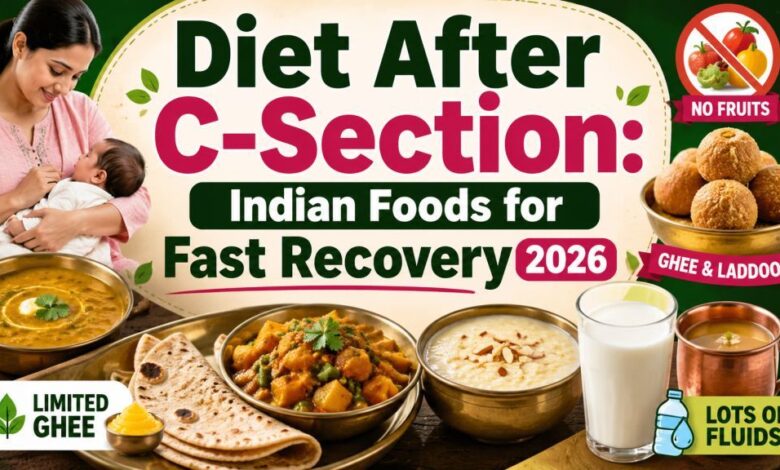
Diet After C-Section: Indian Foods for Fast Recovery 2026
“So… What Can I Actually Eat After a C-Section?” Diet That Heals And Feeds

You just survived major abdominal surgery, there’s a tiny human attached to your chest like a very cute leech, and every aunty in a 10 km radius has a conflicting food opinion.
Welcome to postpartum diet in India.
On one side, your doctor says, “Light, balanced, high protein.” On the other, someone is trying to drown you in ghee laddoos and insists cold water will ruin your stitches. You’re tired, sore, hungry, and honestly just want someone to tell you what to put on your plate without turning it into a family referendum.
This site is about health that actually fits real life especially Indian bodies, Indian kitchens, and Indian drama. Here, we’re not worshipping “perfect” clean eating. We’re asking: what helps your stitches heal faster, keeps your digestion sane, and supports good breast milk without turning you into a full-time diet manager.
So let’s talk about a real diet after C-section: Indian foods that help recovery and breastfeeding, where khichdi, ajwain, ghee, and methi laddoo all have their place but in the right quantity and at the right time.
THE THING NOBODY ACTUALLY SAYS OUT LOUD
Here’s the part most polite articles skip: a C-section is surgery, not a “fancy normal delivery”. Your body has literally been cut open, organs moved, baby taken out, and you are sent home in 3-4 days with a painkiller strip and vibes. Food isn’t a “nice to have” here; it’s part of your treatment.
But because this is India, your treatment is now crowdsourced. One aunt says, “Only hot food, three months, no fruit.” Another says, “Have milk every two hours or your milk will dry up.” Your mother-in-law forwards a WhatsApp on “miracle jeera water to melt tummy fat”. Meanwhile your doctor just says, “Eat healthy.” Cool. Very precise.
Here’s the truth no one prints on hospital discharge papers:
Your post C-section diet has three jobs heal the cut, keep your gut moving, and build milk in that order. If any one of those collapses, everything feels harder: pain increases, gas feels like death, baby feeds go off track.
What actually makes it worse?
- For the first week, heavy, oily, or spicy food feels like betrayal. Your digestion is already slowed from anesthesia, painkillers, and lying around. Throw in aloo paratha drowning in achar and your stomach will protest louder than your newborn.
- Constipation is not a small side effect. Straining with fresh stitches on your abdomen is… memorable. This is why hospitals push soft, easy-to-digest food like khichdi, soups, and plenty of fluids in week one.
- Everyone is obsessed with “more milk”, but very few people talk about basics: enough calories, enough protein, and enough water. Breastfeeding burns around 450-500 extra calories a day, which is basically a whole extra meal
And then there’s the Ayurvedic side that quietly makes sense when you actually live it. Classical postpartum care (sutika paricharya) talks about warm, light, slightly oily food laghu, snigdha, ushna to support digestion and vata balance after delivery. This is why your ajwain water, ghee in khichdi, and warm haldi doodh are not just “old wives’ tales”; they’re targeted tools if used sanely.
The part nobody says out loud is this: you are not eating for Instagram “postpartum fitness goals” right now. You are eating to:
- Replace blood loss with iron-rich food like dates, jaggery, leafy greens, and dals.
- Repair a literal surgical wound with protein from dals, paneer, eggs, or chicken soup.
- Build and maintain milk with regular, not-terrified-of-carbs meals.
Think of it this way: your plate is either helping your stitches and supply, or it’s making your pain and gas worse. There is no neutral food right now.
Read Also: Milk is better for body recovery … Turmeric Milk Benefits (2026): What Science Actually Says
HOW THIS ACTUALLY WORKS THE REAL MECHANICS
Let’s strip the drama and look at what your body is actually trying to do after a C-section.
First: tissue repair. A C-section cuts through skin, fat, fascia, and uterus. Those layers need protein, vitamin C, zinc, and enough calories to rebuild. This is where dal, moong soup, paneer, curd, eggs, and soft chicken or fish come in. In practice, this looks like: one protein source in every main meal, not “two random almonds and a motivational quote”.
Second: digestion reboot. Anesthesia and painkillers slow your gut. Gas-forming foods like chana, rajma, cabbage, or very high-fibre salads can make you feel like your stitches will burst. That’s why week one is all about soft, simple, warm food khichdi, dal with rice, soft roti with ghee, lauki or pumpkin, soups, and herbal teas like ajwain or saunf.
Third: lactation. To make milk, your body needs: water, calories, and micronutrients. Indian diets use oats, methi, saunf, jeera, gond, dill, and dry fruits as galactagogues foods believed to improve supply. When you actually follow a decent chart, it looks like 3 meals + 2-3 snacks, not just one giant “special laddoo” and random tea in between.
Here’s the niche thing generic articles skip: timing. Post C-section, what you eat in week 1 is not what you eat in week 4.
- Week 1: Focus on soft textures and gut comfort. Things like moong dal khichdi with ghee, lauki or pumpkin, rice with thin dal, clear soups, ajwain water, and haldi doodh at night.
- Week 2-4: Gradually increase nutrient density multigrain rotis, more veggies like spinach and beetroot, oats, poha with nuts, curd, papaya, banana, and more visible protein.
- After 1 month: You can start thinking strength and stamina paneer, eggs, chicken soup if you eat meat, more dry fruits, iron-rich foods like dates and jaggery, and a little more raw salad if digestion allows.
A lot of mothers get stuck because they eat “light” for too long just plain rice and thin dal and then wonder why they feel weak and their milk feels low. Light is a phase, not a lifestyle.
Here’s a short, honest list with real opinions:
- Warm ajwain or saunf water: Great for gas and digestion when taken in sips through the day, but not a magic weight-loss drink. Overdoing it while barely eating is just… dehydration cosplay.
- Methi laddoo / gond laddoo: Helpful in moderation for energy, joint support, and lactation, especially for lean women. But three laddoos after every meal “for strength” is basically a dessert buffet.
- Ghee: One to two teaspoons on khichdi or roti can help with bowel movement and energy. Drowning everything in ghee “for recovery” just postpones the “why am I not losing weight” spiral.
- Raw salads: Not ideal in week one when your gut is recovering, especially cabbage, onion, and heavy sprouts. Later, a small kachumber or grated carrot-beet salad is fine if you tolerate it well.
- Caffeine: One small cup of tea or coffee is fine for most mothers, but four cups + poor hydration can mess with your sleep, hydration, and baby’s fussiness.
Mechanics summary: your early diet after C-section in India should feel like hospital food had a baby with your mom’s kitchen soft, warm, simple, but not nutritionally boring.
COMPARISON WHAT’S ACTUALLY DIFFERENT BETWEEN YOUR OPTIONS
Common Post C-Section Diet Styles (Indian Context)
| Option | What it actually does | Who it’s for | The catch |
| Ultra-traditional “only hot, no fruit” | Keeps digestion warm, avoids gas; uses ghee, laddoos, ajwain, methi generously. | Women with weaker digestion, joint pain, very low weight. | Can become heavy, low in fresh vitamins, and over-caloric if not balanced. |
| Doctor-given “balanced Indian diet” | Mix of dal, roti, veg, fruit, milk, limited ghee, lots of fluids. | Most urban mothers with access to variety and help in kitchen. | Often described vaguely; families turn it into their own random version. |
| Weight-loss focused too early | Cuts carbs and ghee, increases raw salad and “diet food”. | Mothers anxious about weight, influenced by social media. | Risks low energy, low milk supply, and poor wound healing. |
| Ayurveda-guided laghu-snigdha-ushna diet | Warm, light, slightly oily, spiced with ajwain, jeera, saunf; structured meals. | Those who like routines, value traditional care, and want digestion focus. | Needs guidance to avoid extremes like “no fruit for months”. |
If I had to pick, I’d lean towards: traditional-Ayurveda base (warm, light, regular meals) plus modern clarity on protein, iron, and hydration from the “balanced diet” version. Go full “no fruit, only ghee and laddoos” or full “raw salad, zero carb diet” and you’ll likely suffer in either digestion or energy.
Also Read: Indian Spices That Boost Immunity (2026 Masala Guide)
WHAT ACTUALLY HAPPENS WHEN YOU TRY THIS
When you actually follow a sane Indian post C-section diet for a few weeks, a few things show up that glossy diet charts don’t talk about.
First week, your relationship with khichdi changes. It stops being “sick people food” and becomes “I can eat this without crying from gas”. A simple moong dal khichdi with ghee and lauki or pumpkin feels ridiculously comforting when you’re bloated from surgery and pain meds. Bowel movement day one or two is a full event; the combination of fibre, ghee, and warm fluids feels less like wellness content and more like rescue work.
Most people find that once they start spacing meals say, breakfast, lunch, evening snack, and dinner with 1-2 small snacks their energy comes back faster than with random, heavy festival-style meals. A bowl of oats with nuts in the morning, dal-chawal-sabzi at lunch, makhana or dry fruits as snack, and roti-dal-veg at night creates this quiet baseline stability. You’re not flying, but you’re not crashing either.
One thing that surprises many women is how directly hydration affects breastfeeding. On days you sip ajwain water, plain water, buttermilk, and maybe a bowl of soup, feeding sessions feel smoother and you feel less wrung out. On days when things are chaotic and you forget to drink, you can feel the difference by night more headache, more fatigue, feeds feel heavier. It’s not mental; it’s literally fluid going out.
There’s also a pattern most generic articles miss: digestion and baby behaviour are linked. When your own gut is a mess from gas-forming foods or too much spice think chole, rajma, heavy restaurant-style gravies your baby often ends up more fussy at the breast. Is it 100% proven for every single food? No. But in practice, mothers consistently report fewer colicky evenings when they stay with simpler, home-cooked, mildly spiced food in the early weeks.
Another thing people don’t warn you about: social pressure. The same person who insisted on feeding you deep-fried snacks “for strength” may comment on your weight at the baby’s naming ceremony. The diet that actually works long term is the one where you can politely accept one gond laddoo, enjoy it, and then go back to your normal plate without spiralling into guilt or defiance.
When you stay with this middle path for 4-6 weeks warm food, one protein per meal, iron-rich foods a few times a week, 2-3 laddoos a day max, and actual water recovery feels less like surviving and more like slowly getting your body back. You still feel tired, yes. But you don’t feel broken.
THE ADVICE EVERYONE GIVES VS WHAT ACTUALLY WORKS
1. “Eat for two or your milk will be weak.”
This one is on repeat. People pile your plate like it’s a wedding buffet. The idea is right breastfeeding does need extra calories but “eat for two” usually translates to “eat double carbs and sugar with no extra protein”. That leads to sleepiness, sluggish digestion, and later, guilt about weight.
What works better: eat for one well-fed adult who is breastfeeding. That means roughly one extra small meal or 2-3 smart snacks dry fruits, milk, laddoo in moderation, fruit with nuts, or an extra bowl of dal not random third helpings of rice.
2. “Avoid all fruit and cold foods for 40 days.”
This one is very popular in traditional setups. The logic is to protect your digestion and avoid “cold” energy after delivery. Some of it makes sense week one icy drinks, aerated sodas, and heavy raw salads can absolutely worsen gas. But extending this into “no fruit at all, no buttermilk ever” can quietly rob you of vitamin C, fibre, and probiotics.
The practical version: in week one, keep fruits cooked or soft and room temperature stewed apple, mashed banana, soft papaya, maybe warm lemon water. After that, if your digestion is stable, you can bring back normal fruit portions and room-temperature buttermilk while still avoiding icy drinks.
3. “Don’t have ghee, it will make you fat.”
Modern advice over-corrects. Old-school families put ghee on everything; new-school ones ban it completely. Reality: a bit of ghee helps your bowels, joints, and energy; too much is a problem. The issue is not ghee itself, it’s ghee plus sugar plus inactivity.
A grounded approach: 2-3 teaspoons of ghee across your day in khichdi, on roti, or in one laddoo is usually fine for most women, especially in the first month when your body is repairing. If you’re pouring it like gravy, that’s where it backfires.
4. “Start dieting early or you’ll never lose the tummy.”
This one smells like Instagram. Cutting carbs aggressively in the first 6-8 weeks may shrink the scale a little, but it can also tank your energy and potentially reduce milk if you’re not careful. Plus, your body is still healing and your hormones are in their own soap opera.
What works: keep weight loss completely off the table for at least 6-8 weeks, and focus on nutrient quality whole grains instead of maida, home food instead of junk, enough protein, and sensible portion sizes. Light walking when your doctor clears you will do more long term than “salad and black coffee” martyrdom in week three.
THE PRACTICAL PART WHAT TO ACTUALLY DO
- Set up a simple Week 1 plate rule.
Decide that every main meal in the first week will have: one soft carb (khichdi, rice, soft roti), one easy dal or light protein, one soft veg like lauki, pumpkin, carrot, or beetroot, and 1 teaspoon of ghee. No menu drama, just repeat this in different combinations so your gut and stitches don’t have to deal with surprises. - Plan 2-3 fixed snacks that help milk, not mood swings.
Instead of random biscuits, choose 2-3 go-to options: a small bowl of oats with nuts, a handful of dry fruits, makhana roasted in ghee, or fruit with curd. If you’re using methi/gond/ajwain laddoos, cap them at 1-2 a day and treat them as a snack, not a side dish for every meal. - Put hydration on autopilot.
Fill a big bottle with plain water and keep smaller glasses of ajwain water, saunf water, or buttermilk at set times morning, noon, evening. Aim for 8-10 glasses total (from water, herbal teas, soups, buttermilk), especially if you’re breastfeeding on demand. - Use a weekly iron-and-protein checklist.
Instead of trying to remember everything, just check: did you have leafy greens (palak, methi, moringa, beetroot) 2-3 times this week? Some kind of dal or lentil every day? Paneer, curd, egg, or chicken soup several times? Dates or jaggery a few times? If yes, you’re already supporting healing better than most people. - Limit the usual suspects: gas and junk.
For at least the first couple of weeks, either avoid or go very easy on rajma, chana, heavy fried snacks, restaurant food, colas, and very spicy masala. When you do introduce stronger foods again, do it at lunch, not dinner, so you’re not testing your stitches and baby’s mood at midnight. - Agree one “food boss” and ignore the rest.
Pick: your doctor, a trusted Ayurvedic practitioner, or one sensible elder who actually listens. Follow one system instead of mixing “no fruit, extra laddoo, also salad and black coffee” into one confused mess. Your body will thank you more for consistency than for chasing every magical tip. - Make a basic 2-week rotation and stick it on the fridge.
Use the Apollo-style week 1-4 logic: softer in week one, more varied in week 2-4. Even a simple chart like: Day 1 khichdi, Day 2 roti-dal-sabzi, Day 3 rice-sambar-veg, etc., helps your family cook for you instead of asking, “What should we make?” when you’re half asleep.
QUESTIONS PEOPLE ACTUALLY ASK
Can I eat rice after C-section delivery?
Yes, you can eat rice after a C-section, especially in the form of soft khichdi or plain rice with light dal. In fact, many Indian hospitals serve rice-based meals in the first week because they’re easy to digest. Just pair rice with protein (dal, curd, or soft sabzi) and some ghee instead of eating only plain rice, so your energy stays stable.
Which Indian foods increase breast milk after C-section?
Typical Indian galactagogues include methi (fenugreek seeds), saunf (fennel), jeera (cumin), oats, green leafy vegetables, gond and dry fruits, and traditional laddoos made with these. Herbs like dill (suva), ajwain, and preparations like gond or methi laddoos, almond halwa, and bajra-based recipes are traditionally used to support lactation. But they work best when added to an overall adequate diet enough calories, protein, and fluids not as magic add-ons to otherwise poor eating.
What foods should I avoid after C-section while breastfeeding?
In the first weeks, try to avoid gas-forming foods like chana, rajma, heavy cabbage, and very spicy or oily dishes, as they can worsen bloating and discomfort. Also cut back on junk foods, deep-fried snacks, aerated drinks, and very sugary foods because they add calories without helping healing or milk quality. Many doctors also suggest limiting caffeine and very cold or refrigerated foods in this period.
Can I drink cold water after C-section?
Medically, there’s no rule that cold water will “damage stitches”, but ice-cold drinks can sometimes worsen gas and discomfort when your digestion is already sensitive. Warm or room-temperature water, ajwain water, and herbal teas are easier on your gut in the first week or two. If you tolerate mildly cool water later on and your digestion is fine, you don’t need to fear it just avoid extremes.
Is ghee really necessary after C-section?
Not “necessary” like a medicine, but ghee in small amounts can help with bowel movement, provide energy, and fit well with the Ayurvedic warm, slightly oily diet principle. Hospitals and dietitians often allow 1-2 teaspoons of ghee daily as part of a balanced diet. Too much, especially combined with lots of sugar and very little movement, can lead to unnecessary weight gain.
When can I start eating normal spicy food again?
If your recovery is smooth, you can usually start easing back into moderately spiced home food after a couple of weeks, starting at lunch. Start with less oily, less chilli-heavy versions to see how your digestion and baby’s mood respond. Restaurant-style heavy gravies and very spicy dishes are better kept for later, once your gut feels robust again.
How many meals should I eat in a day after C-section?
Most breastfeeding diet plans suggest 3 regular meals and 2-3 light snacks per day. This pattern supports healing and lactation better than two giant meals, because your body gets a steady supply of energy and nutrients instead of spikes and crashes. Think: breakfast, mid-morning snack, lunch, evening snack, and dinner as a base.
Can I follow an Ayurvedic postpartum diet if my doctor gave a standard chart?
Yes, you can combine both, as long as you’re not cancelling out medical advice. An Ayurvedic postpartum diet that focuses on warm, light, slightly oily food and digestive spices like ajwain, saunf, and jeera usually fits well with a balanced medical chart. If you plan to take herbs or special formulations like Shatavari with milk, speak to your doctor first, especially if you’re on any medication.
When can I start dieting to lose weight after C-section?
Most guidelines suggest waiting at least 6-8 weeks before actively trying to lose weight, and even then doing it gradually. Your primary focus in the early weeks should be healing, regaining strength, and supporting breastfeeding, not cutting calories aggressively. When you do start, aim for small, sustainable changes better food quality and light activity instead of crash diets.
SO WHERE DOES THIS LEAVE YOU
You’re stuck between three loud voices: tradition pushing ghee and laddoos, modern diet culture screaming “abs by six weeks”, and your own body quietly asking for warm, simple food and water. None of them fully know what your particular recovery feels like. That’s the real tension here.
Diet after a C-section in India doesn’t have to be a battlefield. It can be boring in the best way: khichdi, dal, roti, sabzi, curd, fruit, dry fruits, laddoo in moderation, lots of fluids, and one protein in each main meal. You don’t have to earn this food. Your body literally needs it to close a surgical wound and make milk for another human.
If you do one concrete thing today, let it be this: sit with whoever cooks in your house and set up a 7-day simple menu that follows the week-1 and week-2 logic soft and soothing first, richer and more varied later. It won’t be perfect, and some days will be pure “whatever we can manage”. But you’ll know that, most of the time, your plate is working with your recovery, not against it.
You made it to the end, which either means you’re serious about recovering well or you’re trapped under a sleeping baby and can’t reach the back button. Either way, respect. Most people just skim, but you now know more about post C-section food mechanics than half the WhatsApp family group.
The truth is, there’s no magical “C-section superfood thali”. There’s just a series of boring, solid choices repeated day after day until your body catches up with what it’s been through. One khichdi, one cup of ajwain water, one sensible laddoo, one honest conversation with your family about portion sizes.
If you ever feel guilty for eating “too much” while breastfeeding and recovering from surgery, remember this: your body did the hard part; the least you can do is feed it like you mean it.