How to Lose Belly Fat With Indian Food: A 12-Week Roadmap That Doesn’t Hate Your Life
You know that one button on your jeans that’s fighting for its life?
That’s not “cute belly.” That’s years of random sugar, late-night food, and heroic sitting.
This site exists for one thing: health that fits real life. Not “eat air and drink green liquid” health. Actual Indian food, actual human schedules, and yes, the very real problem of belly fat the stubborn, health-risk kind, not just “I ate extra momos yesterday” kind.
Here’s the part nobody tells you cleanly: you can absolutely shrink belly fat with Indian food over 12 weeks, but you’re not “targeting belly” with some magical sabja seeds and methi water. You’re lowering overall body fat and visceral fat with a boring combo of calorie control, smarter food choices, and consistent movement.
So this is your 12-week roadmap. No gym required. No starvation. Just you, your kitchen (or hostel mess), and some unapologetically honest rules.
THE THING NOBODY ACTUALLY SAYS OUT LOUD
Let’s start with the annoying truth: you cannot “spot reduce” belly fat with just one food, one drink, or one exercise. Your body doesn’t read WhatsApp forwards. When you lose fat, it comes off from different places, and visceral belly fat the deep internal one usually starts dropping once you consistently stay in a calorie deficit and move more.
Yet every second reel screams: “Ajwain water = flat stomach,” “one miracle Indian food for belly fat,” “7 days to abs.” It’s cute as content. Useless as a plan. Real studies on visceral fat reduction talk about weeks of consistent diet plus exercise 12 weeks of combined training significantly reduced visceral fat in college students, for example. That’s three months of boring effort, not seven days of magic.
Here’s the line nobody wants in their thumbnail: your belly is a report card of your overall lifestyle not just what you had for breakfast this week. Long hours of sitting, high sugar intake, processed snacks, low sleep, stress, and totally random meal timings all contribute.
The second silent truth? Indian food is not the villain. The problem isn’t dal, roti, rice, sabzi, curd. The problem is:
- Sugar drinks instead of water.
- Bakery and fried snacks instead of actual meals.
- Huge portions of rice/maida and tiny portions of protein and vegetables.
You can keep eating “normal ghar ka khana” and still burn belly fat if you flip those ratios and stop treating chai-biscuit as a personality trait.
Belly fat is less about one food and more about the pattern of your entire day, repeated for months. That’s why we’re talking about 12 weeks, not 12 days.
Most polished articles also skip the mental part. They talk like you’ll suddenly love salads, wake up at 5 am, and sip methi water while journaling. In real life, you’re 18–25, sleep is chaos, exams exist, hostel mess is random, and you can’t afford Greek yogurt every day. So this roadmap uses things you actually have: dal, roti, rice, veg, buttermilk, curd, sprouts, oats, simple spices.
There’s also this fun lie: “if you’re young, your metabolism will fix it.” Translation: “eat crap, it’ll be fine.” Except we now have more 20-somethings with high belly fat, prediabetes and fatigue than ever, and a lot of that is due to staying sedentary on screens with high-sugar Indian diets.
So if you’re here, you’re already ahead of the curve. You’ve noticed things feel off. Clothes fit strangely. Energy dips. Maybe your reports mentioned borderline sugar or cholesterol. This 12-week roadmap doesn’t give you abs; it gives you less dangerous belly fat and a body that feels more like yours again.
And yes, there will be boring weeks. You’ll hate this plan on week 3 and silently love it on week 9. That’s exactly how real change feels.
HOW THIS ACTUALLY WORKS THE REAL MECHANICS
Let’s translate “nutritionist roadmap” into normal human language.
Belly fat can be subcutaneous (just under the skin) or visceral (around your organs). Visceral fat is the worrying one linked to diabetes, heart disease and a lot of the stuff doctors nag you about. Good news: research shows that when you’re in a calorie deficit and stay active, visceral fat is often the first fat your body uses for energy.
Over 12 weeks, here’s what you’re actually doing:
- Eating fewer total calories than your body needs, but not so few that you crash.
- Increasing protein, fibre and healthy fats so you stay full and preserve muscle.
- Reducing sugar, refined flour (maida), fried and processed foods that love sitting on your belly.
- Adding regular movement walking and simple strength work to tell your body, “we still need this muscle, please burn the fat instead.”
Most Indian belly fat guides write like you’ll follow one rigid 7-day menu forever. That’s not how humans work. A proper 12-week roadmap has phases:
- Weeks 1–4: Awareness and clean-up.
- Weeks 5–8: Structure and consistency.
- Weeks 9–12: Fine-tuning for deeper belly change.
We’ll get to specific actions later. First, here’s the niche angle almost nobody addresses: how Indian food combinations affect belly fat.
Not just “what food,” but how you pair it:
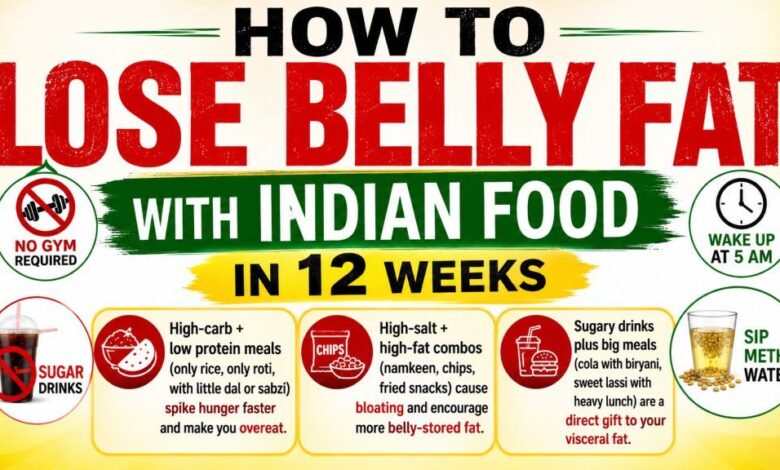
- High-carb + low protein meals (only rice, only roti, with little dal or sabzi) spike hunger faster and make you overeat.
- High-salt + high-fat combos (namkeen, chips, fried snacks) cause bloating and encourage more belly-stored fat.
- Sugary drinks plus big meals (cola with biryani, sweet lassi with heavy lunch) are a direct gift to your visceral fat.
Now, the short list with real opinions:
- High-protein Indian staples (dal, chana, rajma, paneer, curd, eggs, lean meat).
These are your belly-fat kryptonite when used right they keep you full, support muscle, and help you eat less overall. - Fibre-heavy carbs (oats, dalia, millets, vegetables, fruits).
They slow digestion, stabilize blood sugar, and quietly work against your random cravings. - Probiotic foods (curd, buttermilk).
Good for gut health, which indirectly influences weight, inflammation and bloating. - “Fake friends” foods (sugary drinks, bakery items, packaged snacks).
These are the ones that pretend to be “small treats” but are actually heavy calorie bombs going straight to belly and liver. - Healthy fats (nuts, seeds, a bit of ghee, good oils).
Useful in small amounts, but you don’t get extra points for drowning everything in “but it’s desi ghee.”
Once you understand this, belly fat stops feeling like mysterious bad luck. It starts looking like a very boring math and habit problem.
COMPARISON WHAT’S ACTUALLY DIFFERENT BETWEEN YOUR OPTIONS
Here’s what people usually try when they’re desperate about belly fat.
| Option | What it actually does | Who it’s for | The catch |
| 7-day “detox” or liquid-only plans | Fast water loss, bloating drops, minor short-term belly change. | People chasing quick photos, events | No real visceral fat change, rebound hunger, not sustainable past a week. |
| Generic low-calorie Indian diet chart | Overall weight loss with slight belly reduction over time. | Anyone wanting simple, short-term fat loss | Misses long-term structure, doesn’t focus on belly-specific lifestyle drivers. |
| Structured 12-week belly-focused plan | Gradual visceral and subcutaneous belly fat reduction plus habit change. | 18–25-year-olds ready to commit for 3 months | Results are slower, require consistency and some boring adult decisions. |
My take? The 12-week, belly-focused plan is the only one that respects your future, not just your next selfie. The quick fixes feel satisfying now and miserable later; the structured plan feels annoying now and quietly life-changing later.
WHAT ACTUALLY HAPPENS WHEN YOU TRY THIS
Let’s walk through what it feels like, not just what the theory says.
Week 1, you’re in “new plan” mode. You swap your morning chai-biscuit for methi or lemon water plus a real breakfast like oats or moong dal chilla. You reduce sugar, add a little curd and salad to lunch, and skip that evening packet of namkeen. You feel… strangely proud and slightly hungry.
By week 2, you notice something small: your belly feels less “puffy” after meals. That’s not major fat loss yet; that’s lower salt, less junk, and more fibre reducing bloating. You still have a visible belly, but it doesn’t feel like you swallowed a brick.
Around week 4, you step on the scale and see maybe 2–3 kg down if you’ve been consistent. The tape measure around your waist shows a small drop, maybe 2–4 cm. Clothes fit slightly better. That’s a mix of fat and water changes, but it’s real. The biggest shift, though, is invisible: you’re now thinking about food in “plates,” not snacks.
The thing that surprised me when I followed a structured plan like this? How much of belly fat is tied to late-night eating and liquid calories. When you replace sweet lassi, soft drinks and random tea-biscuit runs with water, buttermilk and actual meals, your belly responds faster than your brain expects.
By week 6–8, a pattern appears that most articles completely miss: your social life becomes the real test, not your kitchen. Birthdays, outings, festivals, movie nights these are the places your belly plan either survives or dies. If you keep those events to flexible-but-not-crazy eating (enjoy the main meal, skip sugary drinks and extra sides), you keep moving forward. If you treat every plan break as a “restart Monday,” progress stalls.
Another lived detail: you don’t need perfect workouts to help belly fat. Studies show that regular aerobic and resistance exercise over 12 weeks can significantly cut visceral fat. In practice, that looks like: walking most days, doing basic squats/push-ups/planks, and maybe a few HIIT-style home workouts when you have energy. Nothing gym-heroic, just consistent movement.
By week 9–12, your relationship with food is different. You still eat biryani sometimes. You still have dessert. But your default day now has:
- Real breakfast.
- Balanced Indian lunch with dal, sabzi, salad and measured roti/rice.
- Smart snacks (fruit, sprouts, buttermilk) instead of packets.
- Lighter, earlier dinner.
Your waist drops more visibly now. The belly that felt like a stubborn fixture starts looking like something that can change. That’s the part no 7-day challenge prepares you for the slow shift where your body stops resisting and starts cooperating.
THE ADVICE EVERYONE GIVES VS WHAT ACTUALLY WORKS
Let’s destroy some greatest hits.
- “Just drink water every morning, belly will vanish.”
Fill in the blank: ajwain, jeera, methi, lemon, cinnamon. These drinks can support digestion or appetite control, but on their own they don’t erase belly fat. If your diet is still high sugar and low protein, your belly will happily stay.
Real fix: use these drinks as supporting actors, not main stars. Start your day with them plus a high-protein, high-fibre Indian breakfast like oats, dalia or moong dal chilla. - “Stop eating carbs, that’s why your belly is big.”
Over-simplified nonsense. Most Indian diets revolve around carbs roti, rice, idli, dosa, poha, etc. Cutting them completely isn’t sustainable for most families.
Better approach: switch to smarter carbs and smaller portions. Think oats, dalia, millets, brown or red rice, more vegetables and fruit instead of giant piles of white rice and maida. - “Do only abs exercises, they burn belly fat.”
Nope. Crunches and planks strengthen your core; they don’t specifically burn belly fat without a calorie deficit. Visceral fat responds best to overall weight loss plus regular aerobic and strength exercise.
Effective combo: brisk walking, simple strength moves (squats, push-ups, lunges), and a few core exercises plus a controlled Indian diet. Your belly changes because your whole system changes, not because one muscle is suffering alone. - “Buy this special fat-burning product/supplement.”
Some products can help with appetite or protein intake, but many are just expensive versions of things you can get from normal Indian food. They also tempt you to keep eating junk because “the product will handle it.” Spoiler: it won’t.
Sane alternative: focus on real foods known to support belly fat loss beans, yogurt/curd, vegetables (especially green and colorful ones), whole grains, nuts, and seeds. Supplements are optional; this base is not. - “Young people don’t need to worry, it will go away.”
Tell that to the 22-year-olds already dealing with insulin resistance and central obesity. Belly fat is not a “future you” problem anymore.
My opinion? If your belt feels tighter every semester, that’s your wake-up call. Better to fix it with a 12-week plan now than wait for the doctor-version of this same conversation later.
THE PRACTICAL PART WHAT TO ACTUALLY DO
Here’s your 12-week roadmap, stripped of fluff. Adjust foods for veg/non-veg and hostel/home, but keep the logic.
1. Lock a basic meal structure for all 12 weeks.
Aim for 3 main meals + 2 snacks: breakfast, lunch, dinner, plus mid-morning and evening snacks. No “I’ll just randomly graze.” Keep meals 3–4 hours apart, with dinner at least 2–3 hours before sleep. This alone cuts late-night belly bombs.
2. Build a default belly-friendly plate for lunch and dinner.
Half plate = vegetables and salad. One-quarter = protein (dal, chana, rajma, paneer, tofu, eggs, lean meat). One-quarter = carbs (roti, rice, or millets). Less oil, controlled portions, same ghar ka khana. You follow this plate most days for all 12 weeks.
3. Clean up your liquids. Completely.
For 12 weeks, avoid sugary drinks: soda, sweet lassi, energy drinks, packaged juices. Switch to water, unsweetened tea, black coffee, buttermilk and tender coconut water. Belly fat loves liquid sugar; you’re cutting its main fuel line.
4. Choose 4 realistic breakfast options and rotate.
Pick from oats porridge, dalia, moong dal chilla, idli with sambar, or egg-based combos; keep oil low and add fruit or veg. Rotate through them so you don’t get bored. Breakfast sets your hunger mood; if you mess this meal, your belly pays later.
5. Set weekly movement rules, not inspirational goals.
Aim for at least 30 minutes of walking most days, plus 2–3 short strength sessions per week (bodyweight exercises at home). This combination is what studies keep pointing to for visceral fat reduction over 12 weeks. Track steps or time in your phone; numbers keep you honest.
6. Plan your “flex meals” ahead of time.
You’re 18–25. Life has biryani, pizza, birthdays. Choose 2–3 meals per week that can be flexible, and keep the rest strictly on-plan. That way you’re not pretending you’ll never eat fun food; you’re just preventing it from becoming your default.
7. Track waist and habits weekly, not obsessively daily.
Measure your waist once a week, same time of day. Note things like “late-night eating,” “sugary drinks,” “movement.” The goal isn’t a perfect chart; it’s catching patterns. If your numbers stall, you’ll usually find the reason in those notes.
Follow these seven things for 12 weeks and belly fat becomes less mysterious. It won’t vanish. It will shrink. That’s what we’re here for.
QUESTIONS PEOPLE ACTUALLY ASK
How long does it really take to lose belly fat with Indian food?
You’ll usually see some change in 4–6 weeks, but significant, safer belly fat reduction often needs around 12 weeks of consistent diet and activity. The first few weeks mostly improve bloating and overall energy; deeper visceral fat shift takes time. Using balanced Indian meals with more protein, fibre and fewer sugary, fried foods can make that process smoother and realistic.
Which Indian foods actually help reduce belly fat?
Think less “magic food” and more “supportive pattern.” Beans, lentils (dal, chana, rajma), yogurt/curd, vegetables, whole grains like oats and dalia, fruits and nuts all support belly fat loss when used in a controlled-calorie diet. Probiotic foods like curd and buttermilk help gut health and bloating. On the flip side, sugary drinks, processed meat, bakery snacks and fried namkeen are things to minimize if you care about your waistline.
Can I lose belly fat without going to the gym?
Yes. Diet is the base; movement is the amplifier. Regular walking, home workouts and simple strength exercises can reduce visceral fat effectively when combined with a good Indian diet. Aim for at least 30 minutes of brisk activity most days and 2–3 short sessions of bodyweight strength work weekly, while sticking to balanced meals. The gym can speed things up, but it’s not mandatory.
Is it enough to just do ab exercises for belly fat?
No. Ab exercises alone don’t directly burn belly fat; they strengthen your core muscles underneath. Belly fat responds best to a combination of calorie deficit, overall movement, and consistent strength training of the whole body. Doing planks, crunches and leg raises can be part of your routine, but the main change comes from your diet and total activity, not one muscle group suffering separate from the rest.
What should I avoid in my Indian diet to shrink belly fat?
You’ll want to cut down on sugary drinks, sweets, bakery items, fried and packaged snacks, and heavy refined flour foods like white bread and maida-based junk. These add a lot of calories with almost no nutrition and are closely linked to increased belly and visceral fat. Also keep an eye on late-night heavy meals and excess alcohol; both are known to push fat toward your midsection.
Is a vegetarian Indian diet enough to reduce belly fat?
Yes, a vegetarian Indian diet can be very effective for belly fat loss if you focus on protein and fibre. Dal, chana, rajma, sprouts, paneer, tofu, curd, vegetables, fruits and whole grains like oats or millets together create a strong base. The key is to avoid falling into the “only carbs” trap too much rice/roti and too little protein or veg will slow your progress even if you’re vegetarian.
How important is sleep and stress for belly fat?
Very. Belly fat is strongly linked to stress hormones and poor sleep. Guides on reducing visceral fat consistently mention at least 7 hours of good sleep and stress management as part of the plan, along with diet and exercise. If your food and movement are fine but you’re sleeping 4–5 hours, constantly anxious and surviving on caffeine, belly fat will resist more.
Can I still eat biryani, pizza or sweets on this 12-week plan?
Yes, but not like they’re daily vegetables. Most successful plans allow 1–2 “flex meals” per week, where you eat what you want but keep other meals that day controlled. This way you enjoy social food without making it your default. If you treat every weekend as a food festival, your belly fat roadmap turns into a circle instead of a line.
SO WHERE DOES THIS LEAVE YOU
If you were hoping for “12 weeks to six-pack,” you know by now that’s not this article. This is “12 weeks to a noticeably smaller, less risky belly and a lifestyle you don’t have to abandon the second life gets busy.”
Your situation is simple and messy at the same time. Simple because the rules are clear: fewer calories, better Indian food choices, more movement, better sleep. Messy because you’re living with exams, friends, parents, hostel mess, festivals, stress, and the occasional entire box of sweets. No roadmap fixes that perfectly.
One concrete thing you can do today? Start with your liquids. For the next week, swap every sugary drink cola, sweet lassi, packaged juice for water, unsweetened tea, or buttermilk. Do nothing else yet. Watch how your hunger, energy and belly feel after just that change. Then add the plate rules. Then add the movement. Stack it.
It won’t be fast. It won’t be dramatic. But 12 weeks from now, you can either still be negotiating with that one stubborn jeans button… or quietly wondering why you didn’t start earlier.
CONCLUSION
If you’re still reading, you’re officially more serious about your health than most people who just save workout reels and forget about them.
You now know this: losing belly fat with Indian food is not about “magic ingredients,” it’s about boring, repeated choices more dal and vegetables, fewer sugary drinks and fried packets, steady walking and strength work, and a 12-week window where you stop lying to yourself about what you’re eating.
So here’s the line to carry with you: your belly isn’t stubborn, it’s just loyal to your habits. Change the habits, and the belly eventually gets the memo.





One Comment