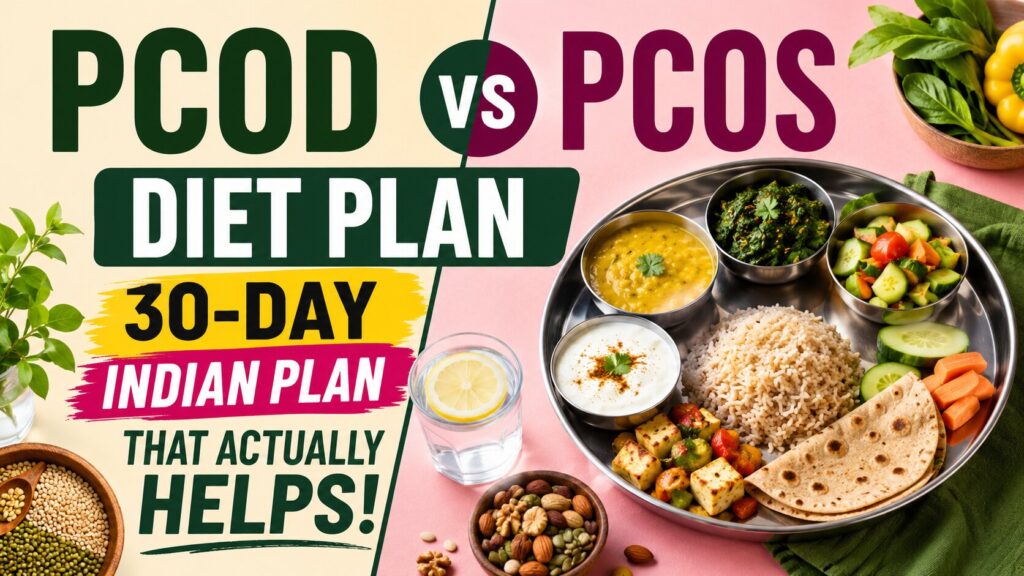
PCOD vs PCOS: The Diet Difference No One Explains Properly
If you’re a woman in India between 18 and 35, there’s a decent chance someone has casually diagnosed you with “PCOD” in a WhatsApp chat before an actual doctor did.
One day you just wanted to know why your skin is angry, your jeans are tight, and your period behaves like an unreliable Zomato delivery.
You google “PCOD vs PCOS” and suddenly you’re in a maze of pastel infographics and vague advice to “eat healthy” and “manage stress”. Very helpful. Thanks.
This site lives in the health space, specifically where hormones, food, and Indian life collide.
So this isn’t another “avoid junk food” lecture. This is about one thing: how the right Indian, mostly Ayurvedic-style diet can actually shift your PCOD or PCOS symptoms in about 30 days not magically cure them, but make daily life less of a hormonal soap opera.
THE THING NOBODY ACTUALLY SAYS OUT LOUD
Let’s say it plainly: most PCOD/PCOS advice is written like you’re a full-time patient with a personal chef and a yoga teacher on retainer.
In reality, you’re eating whatever your family cooks, your office canteen serves, or Swiggy brings at 10 pm when you’re too tired to argue with your ovaries.
Here’s the first uncomfortable truth: PCOD and PCOS are not the same drama level.
PCOD (polycystic ovarian disease) is mainly about your ovaries releasing too many immature eggs, leading to multiple small cysts and sometimes irregular periods; it’s often milder and more of a “lifestyle and hormonal imbalance” situation.
PCOS (polycystic ovary syndrome) is a full-body endocrine and metabolic condition it pulls in insulin resistance, weight gain around the belly, higher androgens (hello chin hair), and long-term risks like diabetes and heart disease.
Most people around you, including some relatives and even a few doctors, will throw these words around like synonyms.
They’re not.
PCOD is like your system saying, “Can you not?”
PCOS is it saying, “We need a full meeting, now.”
Second thing no one tells you: your diet in India is already wired to push your hormones either toward chaos or toward some kind of balance.
Three things show up again and again in Indian women with PCOS: lots of refined carbs (maida, white rice), random eating times, and stress levels that could power a small city.
Ayurvedic doctors will say vata/pitta/kapha, modern doctors will say insulin/inflammation/hormones but they are often pointing at the same food patterns: too much sugar, too much deep-fried stuff, not enough fibre or protein, and meals skipped or eaten at weird times.
Here’s the part many “Instagram diet plans” skip: you cannot copy a Western PCOS plan made for salads, salmon, and almond milk and paste it on an Indian kitchen running on rotis, dal, bhindi, and chai.
You need an Indian version that respects what’s actually on your plate: millets instead of maida, ghee in moderation, dal as protein, and spices like haldi, methi, jeera actually doing some work for your hormones.
Also, nobody says this out loud, but you’re not going to give up all dairy, all rice, and all sweets forever.
You’re just not.
The real win is when your daily pattern supports your body so well that the occasional rasmalai doesn’t wreck your cycle for two months. That’s the balance that matters.
And yes, you will still see “Just lose weight” as advice.
As if you didn’t notice your jeans shrinking on their own.
Weight can matter for PCOS, but for a lot of women, the sequence is flipped: hormones and insulin go weird first, then the weight clings on like a bad ex and diet is how you slowly take the power back, one very unsexy roti swap at a time.
Check Out this Best Ayurvedic Diet Plan for Each Season (2026 Guide)
HOW THIS ACTUALLY WORKS THE REAL MECHANICS
Let’s put the drama aside and talk mechanics.
Whether you have PCOD or PCOS, two big systems are usually involved: insulin and inflammation.
Insulin is the hormone that moves sugar from your blood into your cells.
In PCOS especially, your cells stop responding properly this is insulin resistance so your body keeps pumping more insulin.
High insulin then nudges your ovaries to make more androgens (male-type hormones), which leads to acne, hair growth where you don’t want it, hair loss where you do want it, and messed up ovulation.
When you keep eating a high refined-carb diet white bread, biscuits, sugary chai, fried snacks you’re basically handing this system more fuel to malfunction.
Inflammation is the second troublemaker.
Chronic low-grade inflammation is common in PCOS and is linked to higher androgens and worse insulin resistance.
Ultra-processed foods, deep-fried snacks, sugary drinks, and long gaps without food that push your body into mini panics can all keep that inflammation simmering.
The Ayurvedic-style Indian diet that actually helps usually does three things at once:
- Lowers the glycaemic load (how fast your blood sugar jumps)
- Calms inflammation
- Supports digestion and regular bowel movements, which matter way more for hormones than Instagram cares to mention
Read Also: Seasonal Fruits and Veggies Chart India (2026 Guide)
Typical patterns that work well for PCOD/PCOS in India look like this:
- More whole grains (millets, brown rice, multigrain atta) instead of maida or giant piles of polished white
- Dal, lentils, paneer, curd, eggs, fish, or lean chicken in most main meals for protein
- 4–5 servings of vegetables a day, especially green and colourful ones lauki, methi, palak, carrot, capsicum, bhindi, beans
- Healthy fats like nuts, seeds, a bit of ghee, and good oils instead of everything coming out of a kadhai
- Warm, freshly cooked meals eaten at regular times, instead of random snacking and huge late dinner
Here’s the niche angle most generic PCOS articles ignore: how you eat in an Indian home matters almost as much as what you eat.
You might technically be eating “PCOS-friendly foods”, but if your entire pattern is: chai + biscuits at 8, nothing till 2, huge lunch, more chai, then enormous dinner at 10:30 your insulin is still on a rollercoaster, and your hormones notice.
A few real-world truths from women who’ve actually tried to fix this:
- Low-GI Indian foods work better than forcing yourself to eat alien “diet food”.
When women switch to things like multigrain rotis, millets, dal, sabzi, and nuts, they often report fewer energy crashes and reduced cravings within 2–4 weeks. - Fibre is not just for “weight loss”; it’s for hormone clean-up.
25–35 grams of fibre a day from veggies, fruits with skin, lentils, and whole grains helps your body metabolise and clear hormones better and keeps your gut happier. - Spices are mini-medicines when used with some sense.
Turmeric, cinnamon, methi seeds, and ajwain have data and traditional backing for supporting metabolism, reducing bloating, and improving insulin sensitivity when used regularly, not just as a “detox week”. - Regularity beats perfection every single time.
Eating roughly at the same times, not skipping breakfast, and avoiding huge late-night meals can do more for your cycle in 30 days than one week of extreme “no carb” drama.
In practice, this means your “PCOD vs PCOS diet” is less about a special magical food and more about making your usual Indian meals lighter, more fibrous, and more steady on blood sugar.
It’s deeply boring.
It also works disturbingly often.
COMPARISON WHAT’S ACTUALLY DIFFERENT BETWEEN YOUR OPTIONS
Here’s the part everyone confuses: diet for PCOD vs PCOS is not two separate religions.
It’s the same temple, different intensity of rituals.
| Option | What it actually does | Who it’s for | The catch |
| PCOD-focused Indian diet | Balances mild hormonal imbalance, supports ovulation, reduces irregular cycles. | Women with irregular periods, mild symptoms, few metabolic issues. | Needs consistency; results are subtle but build over months. |
| PCOS-focused Indian diet | Targets insulin resistance, weight, inflammation, and higher androgens. | Women with weight gain, acne, facial hair, long cycle gaps. | Stricter on carbs and sugar; you notice when you “cheat” too often. |
| Generic “healthy eating” | Improves nutrition a bit but doesn’t directly tackle insulin or hormones. | People just trying to “eat better” without a specific condition. | Too vague; usually fails to shift PCOS/PCOD symptoms in a meaningful way. |
If you actually want change in 30 days, go specific.
For PCOD, gentle but consistent changes in your Indian meals and timings are usually enough to see better energy and more predictable cycles.
For PCOS, you probably need a stricter low-GI, higher-protein pattern with almost ruthless control on sugar and refined flour for at least a month to see real shifts.
Read Also: Home Remedies for Cold & Cough (2026) You Can Actually Make
WHAT ACTUALLY HAPPENS WHEN YOU TRY THIS
Here’s what usually happens when someone with PCOS in India decides, “Fine, I’ll actually do this diet thing properly for a month.”
Week 1 is mostly about irritation.
You realise how often food is just… there. Office samosas. Mom’s evening pakoras. Random sweets because a cousin got engaged. Saying “no” feels like a full-time job.
You spend too much time reading food labels and googling “is makhana actually healthy or is Big Makhana lying to me”.
If you stick with it, by around day 7–10, something small but real shifts: your energy is less crashy.
You don’t need chai to stay upright at 4 pm.
Your cravings change not disappear, but they move from “I will die without cake” to “I could eat, but I’m not shaking”.
Women on low-GI Indian plans with more protein and fibre often report less intense hunger and fewer binge episodes within the first two weeks.
The surprising part? Bloating.
Most people expect weight to change first, but often it’s your abdomen that feels less like an overblown balloon after meals.
When you cut back on deep-fried snacks, packaged stuff, and huge carb-heavy meals at night, the constant feeling of “I’m always swollen” calms down a bit.
By week 3, if you’ve been at least 70% consistent (yes, that’s a realistic number), a few things can happen:
- Your sleep might get a bit more stable, especially if you stopped heavy late-night dinners and excess caffeine.
- Your skin may not “clear” like a filter, but new breakouts reduce in intensity; acne feels less inflamed because your insulin and inflammation are quieter.
- For PCOD, some women see their cycle showing up closer to schedule, or at least not completely ghosting them.
The pattern nobody talks about: your mood.
When your blood sugar stops spiking and crashing, your mood swings often soften.
That doesn’t mean no bad days hormones are still doing their own dance but the emotional cliff drops after a high-sugar snack become less dramatic.
What nobody warns you about: there’s usually a moment, around day 15–20, where you think, “This is doing nothing; I should just eat whatever.”
But if you track your sleep, energy, bowel movements, and cravings, there’s usually clear progress long before the scale moves.
The problem is, most of us only track the kg number and then decide the diet is failing, while our hormones are quietly saying thanks in the background.
For PCOS, long-term changes like more regular ovulation or reduced facial hair growth take months, not 30 days.
But those first 30 days are when you prove to yourself that your body does respond, which is honestly half the battle.
You realise this is less of a fairy-tale cure and more of a long, slightly boring friendship with your meals and once that expectation is set, the whole thing gets easier.
THE ADVICE EVERYONE GIVES VS WHAT ACTUALLY WORKS
Let’s go through some popular advice you’ve probably heard and why it’s… incomplete, at best.
- “Just lose weight and your PCOS will fix itself.”
This one is everywhere and also backwards for many women.
Weight can worsen symptoms, yes, but in PCOS, insulin resistance and hormonal imbalance often come first and cause the weight gain.
So telling someone to “just lose weight” without fixing the underlying insulin chaos is like yelling at a smoke alarm without looking for the fire.
A better approach: focus on blood sugar control low-GI foods, protein at each meal, and smaller, regular meals. Weight loss becomes a side effect, not the only goal.
- “Cut all carbs. Go zero sugar, zero rice, zero roti.”
Extremely all-or-nothing advice sounds strong on Instagram but collapses in real kitchens.
Most Indian meals are built around carbs roti, rice, idli, dosa, poha and pretending you can permanently live on salads and grilled paneer is fantasy for 90% of households.
Also, extremely low-carb diets can backfire for some women by increasing stress hormones and binge episodes.
What actually works: choosing the type and portion of carbs multigrain rotis, millets, smaller portions of rice, and always pairing carbs with protein and fibre.
- “Go dairy-free, gluten-free, everything-free.”
For some women, dairy or gluten does make symptoms worse, especially bloating or acne.
But going fully dairy-free and gluten-free is a big social and financial lift in India, and many women don’t need that to see progress.
The smarter first step is to reduce excess dairy (multiple cups of sugary milk tea, flavoured yoghurts, paneer three times a day) and see how your body reacts.
If symptoms still flare, then you experiment with further restrictions based on your body, not someone else’s Instagram reel.
- “Just take Ayurvedic herbs and you’ll be fine.”
Ashwagandha, shatavari, and other herbs get a lot of attention, and yes, some have promising data and long traditional use.
But if your daily diet is still high-sugar, low-fibre, and full of late-night fried food, herbs are like putting a fancy air freshener in a burning kitchen.
Ayurveda, properly understood, is obsessed with food timings, digestion, and daily rhythm not just popping pills labeled “PCOS kit”.
So the grounded version: talk to a qualified practitioner if you want herbs, but anchor everything in a sattvic-ish, warm, freshly cooked, low-junk Indian diet first.
THE PRACTICAL PART WHAT TO ACTUALLY DO
This is where we stop ranting and get into specifics.
Here are concrete steps you can actually execute in a normal Indian life.
- Fix your first meal: protein + fibre, not sugar.
If your day starts with chai and biscuits, you’ve already pushed your insulin uphill.
Switch breakfast to something like vegetable besan chilla with chutney, multigrain roti with paneer bhurji, or vegetable oats with a boiled egg or curd.
The rule: at least one protein (dal, paneer, curd, egg) and one veg in breakfast. Your 4 pm self will thank you.
- Make your roti and rice work for you, not against you.
Keep carbs, but change the format.
Use multigrain atta, jowar, bajra, or ragi instead of only wheat or maida; go for 1–2 rotis plus big portions of sabzi and dal rather than 4 rotis and a sad spoon of vegetables.
If you love rice, take a small bowl of brown rice or hand-polished rice with lots of dal and sabzi instead of a mountain of plain white rice.
- Add one PCOS-friendly snack, remove one junk habit.
Don’t try to overhaul everything.
Pick one junk pattern evening fried snacks, sugary tea four times a day, or nightly dessert and replace it with roasted chana, nuts, sprouts chaat, or a fruit with some seeds.
One swap done consistently for 30 days beats five extreme rules you quit in a week.
- Use spices like tiny daily treatment.
Stop treating spices as background noise.
Add a pinch of haldi and black pepper to your dal, use methi seeds soaked overnight in small amounts if your practitioner okays it, and try jeera-coriander-fennel (CCF) water or cinnamon tea instead of that third coffee.
These won’t fix everything, but they gently support digestion, insulin, and bloating.
- Set boundaries with late-night eating.
For PCOD and PCOS, heavy late dinners are constant saboteurs.
Aim to finish dinner 2–3 hours before sleep: roti + sabzi + dal, or a bowl of dal and grilled/sauteed veggies, or a light khichdi with lots of vegetables.
If you’re hungry later, go for something tiny and light like herbal tea with a few nuts instead of another full meal.
- Track symptoms, not just weight.
For 30 days, keep a simple notes app log: energy (1–10), mood, bloating, sleep quality, and period status.
You’ll often see signs of progress fewer crashes, better digestion, less extreme cravings long before the scale does anything dramatic.
This keeps you going when your brain wants visible Instagram-style “before/after” proof.
Read Also: Giloy vs Ashwagandha vs Shatavari (2026 Guide)
QUESTIONS PEOPLE ACTUALLY ASK
what is the difference between pcod and pcos in females
PCOD (polycystic ovarian disease) mainly affects the ovaries: they release many immature eggs, leading to multiple small cysts and more mild hormonal issues.
PCOS (polycystic ovary syndrome) is a larger hormonal and metabolic disorder that affects your whole body, including insulin, weight, and androgen levels.
PCOS is usually more severe, has higher long-term health risks, and often needs stricter lifestyle and medical management.
can indian diet really improve pcos in 30 days
You’re not “curing” PCOS in 30 days, but you can absolutely reduce symptoms and improve energy when you follow a low-GI, high-fibre, higher-protein Indian pattern.
Women often report fewer cravings, reduced bloating, and better energy within 2–4 weeks of consistent changes.
Cycle regularity, skin, and hair changes usually take longer, but those first 30 days prove your body is responsive.
which indian foods are best for pcos weight loss
For PCOS, the heavy lifters are: multigrain rotis or millets, dal and lentils, paneer or curd in moderation, eggs or lean chicken/fish, and tons of vegetables like lauki, methi, palak, bhindi, and capsicum.
Healthy fats like nuts, seeds, a bit of ghee, and cold-pressed oils help with satiety so you don’t end up bingeing later.
The trick is pairing these with smaller portions of refined carbs and cutting back on sugary drinks and fried snacks.
what foods should i completely avoid in pcod and pcos
You don’t need a lifelong ban list, but some things are worth keeping rare: sugary soft drinks and juices, sweets, bakery items made with maida, packaged snacks, and regular deep-fried street food.
These spike insulin, fuel inflammation, and make symptoms worse over time.
High intake of refined carbs like white bread and big piles of polished rice is also unhelpful keep them limited or switch to better versions.
is ayurvedic diet really different from a normal pcos diet
An Ayurvedic-style diet focuses on warm, fresh, lightly spiced, sattvic meals, regular timings, and not overloading digestion which lines up surprisingly well with what modern PCOS guidelines suggest.
It emphasises whole grains, seasonal vegetables, moderate good fats, and herbs like haldi, jeera, methi, and ajwain.
The difference is more about philosophy and consistency than magical foods: you eat in a way that keeps your digestion and blood sugar steady instead of yo-yoing.
can i eat rice if i have pcos or pcod
Yes, rice is not banned, but the type and amount matter.
Smaller portions of brown rice or hand-polished rice with plenty of dal and vegetables are much kinder to your insulin than large plates of plain white rice.
If you’re more insulin-resistant (common in PCOS), keep rice portions modest and avoid having it as the main star of the plate.
does dairy make pcos worse for indian women
For some women, high dairy intake can worsen acne or bloating, and some experts suggest limiting excessive milk and dairy products for PCOS.
But many women tolerate moderate amounts of curd or paneer very well, especially when the rest of the diet is balanced.
Instead of banning dairy overnight, start by cutting back on sugary milk teas and heavy, cheesy dishes, then see how your body responds.
how soon can my period become regular with diet changes
For PCOD, some women see more regular cycles within a few months of consistent diet and lifestyle changes.
For PCOS, it can take longer because insulin resistance and androgen levels also have to shift.
Diet is one pillar; sleep, stress, movement, and medical treatment (if needed) should work with it, not instead of it.
do i still need medicine if i fix my diet
Sometimes yes, sometimes no and that’s a doctor-level call.
For milder PCOD, some women manage well with diet, exercise, and weight management alone.
For PCOS with significant insulin resistance, long cycle gaps, or fertility goals, medicines like metformin or hormonal treatment might be part of the plan along with diet, not instead of it.
SO WHERE DOES THIS LEAVE YOU
So here you are: staring at your kitchen, your cravings, your family’s eating patterns, and your lab reports.
It’s a lot.
PCOD and PCOS are not personality flaws or punishment for liking biryani; they’re complex hormonal conditions living in a world full of cheap, easy, hormone-unfriendly food.
The honest truth is this: a 30-day Indian, Ayurvedic-style diet shift will not turn your life into a wellness ad.
You will still have annoying days, cravings, mood swings, and probably relatives who say unhelpful things about your weight or marriage plans.
But in a month, you can realistically expect better energy, fewer sugar crashes, less bloating, and the early signs of your cycle calming down especially if your condition leans more toward PCOD than severe PCOS.
Your one concrete action for today?
Pick just two changes from the practical list fix breakfast, switch your rotis, cut one junk snack, or enforce a lighter, earlier dinner and commit to them for 30 days like an experiment, not a moral test.
No drama, no “perfect diet” fantasy, just quiet, stubborn consistency.
It won’t be easy, and it won’t always be pretty.
But your body is not your enemy, and it is far more responsive to these small, boring, repeated choices than all the dramatic reels in your feed combined.
CONCLUSION
If you’ve made it this far, you already care more about your health than most of the internet thinks you do.
You don’t need another pastel infographic; you need a plan that fits in a pressure cooker schedule and a joint family kitchen.
So here’s the line that matters: your PCOD or PCOS will not magically disappear, but your daily life with it can become much less chaotic and food is the lever you control most.
Start small, keep receipts (aka symptom tracking), and treat the next 30 days like data collection, not a pass–fail exam.
And if one evening you end up eating jalebi after a long, awful day, it doesn’t cancel your progress.
It just makes you human which, frankly, you already were before the diagnosis.
__________________________________________________________________________
EDITOR NOTE: This article should link internally to articles about “7-Day Indian PCOS Meal Plan (Veg & Non-Veg)”, “Ayurvedic Morning Routine for Hormone Balance”, and “Best Forms of Exercise for PCOS and PCOD in Indian Women”.