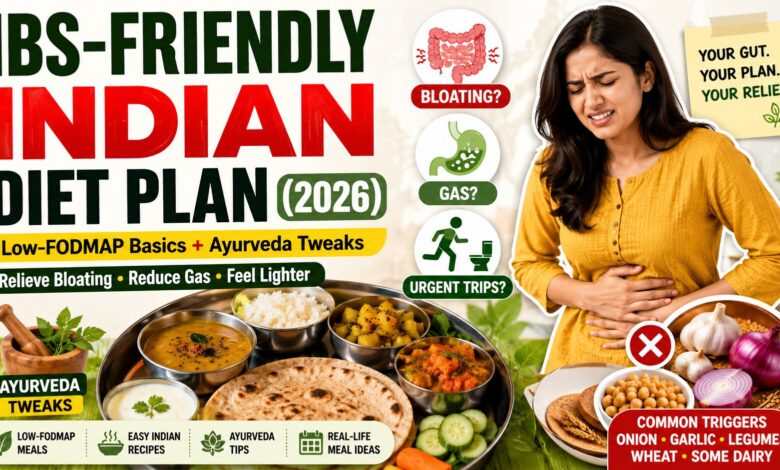
IBS-Friendly Indian Diet Plan: How To Eat Without Always Scanning For The Nearest Toilet
If you have IBS, your relationship with food is… complicated.
You don’t eat a meal; you negotiate with it.
You go from “this looks tasty” to “will this ruin my day in 45 minutes” in one bite. Bloating, gas, cramping, constipation, sudden diarrhea all for the crime of eating normal Indian food.
Gastroenterologists now lean heavily on structured diets like low FODMAP, gluten reduction in some cases, and simple, low-irritant Indian meals to manage IBS symptoms. Ayurvedic doctors, meanwhile, talk about agni (digestive fire), vata/pitta imbalance, simple warm meals, and some very specific food rules that when you look closely actually match a lot of IBS logic.
This guide is where they meet: IBS-friendly, Indian, mostly low-FODMAP-ish, with Ayurvedic sanity checks designed for people who like real food and also like not sprinting to the bathroom after it.
Medical sanity line: IBS is a diagnosis made after ruling out other conditions. Don’t self-diagnose. Use this as guidance only after your doctor has ruled out infections, IBD, celiac, etc., and ideally with a dietitian on board.
THE THING NOBODY ACTUALLY SAYS OUT LOUD
Nobody says this plainly, so let’s do it:
Most “IBS diet” advice in India is either “eat more fibre” or “avoid spicy food.”
Both are sometimes useful. Sometimes a disaster.
Here’s the annoying truth from actual IBS diet charts and low-FODMAP Indian guides:
- IBS is not just “weak digestion” it’s a gut-brain thing.
- Your intestines are hypersensitive to stretch and certain fermentable carbs (FODMAPs), and your nervous system amplifies every little signal.
- That means the same chana masala your friend digests happily can give you gas, pain and a 3-trip date with the toilet.
Indian low-FODMAP resources and IBS diets spell out what your gut is actually reacting to:
- FODMAP = fermentable oligosaccharides, disaccharides, monosaccharides and polyols.
- In Indian food, big culprits include:
- wheat (and wheat-heavy rotis/parathas for many),
- onions and garlic (yes, the base of most sabzis),
- rajma, chole, black chana, and some other legumes,
- some fruits (apple, mango in large amounts, watermelon, etc.),
- milk for people who are lactose sensitive.
One detailed Indian FODMAP analysis found that the major FODMAP group in our average diet is oligosaccharides (fructans and GOS), mostly from wheat, onion and garlic.
IBS diet plans from Indian gastro clinics now look like this:
- Base meals on low-FODMAP staples: rice, some millets, oats, potatoes, many vegetables, eggs, chicken, fish, paneer and curd in tolerated amounts.
- Strictly avoid or sharply limit onion, garlic, heavy beans, some fruits and sweeteners during the elimination phase.
- Then reintroduce foods one by one to see what your gut hates personally.
Ayurvedic IBS diet charts, written in a totally different vocabulary, quietly recommend almost the same pattern:
- warm water, aloe vera, light veg upma, chapati with veg or dal, oats, khichdi, buttermilk, simple veg soups;
- avoid refined flour, fried food, junk, heavy meat, very spicy stuff, too much oil, and erratic meals.
The thing nobody prints in huge font:
There is no single IBS-friendly Indian diet there is your IBS-friendly Indian diet plus a set of patterns that usually help.
And yes, that means:
- your cousin’s “but wheat is fine for me” is completely irrelevant,
- your co-worker’s “just cut dairy” might help them and wreck you,
- your job is to systematically figure out your triggers, not copy-paste someone else’s reel.
HOW THIS ACTUALLY WORKS THE REAL MECHANICS
Let’s translate “IBS-friendly” and “low FODMAP” into something that explains both your gas and why onion suddenly became your enemy.
1. IBS, FODMAPs and Indian food
IBS is a functional gut disorder your gut looks normal on tests, but function is abnormal: motility and sensitivity are off.
FODMAP carbs are:
- poorly absorbed in the small intestine for some people,
- pull water into the gut,
- get fermented by gut bacteria → gas, bloating, pain.
In Indian diets, research has found big FODMAP sources:pmc.
- wheat (and wheat-based foods),
- onion, garlic,
- legumes like rajma, chickpeas, black chana,
- some milk products (if lactose-intolerant),
- certain fruits and sweeteners.
So a classic low-FODMAP Indian pattern does this in phases:
- Elimination (4–6 weeks): cut most high-FODMAP foods.
- Reintroduction: test one food/group at a time to see what you actually react to.
- Personalisation: build your long-term IBS-friendly pattern from the foods you tolerate.
2. IBS-friendly Indian foods: the “safer” bucket
Indian low-FODMAP guides and IBS charts point to a bunch of staples that many people tolerate better (not perfectly, but better):
- Grains & starches (in the elimination phase):
- rice (plain, idli/dosa from well-fermented batter for some),
- some millets (like ragi/foxtail/bajra in moderate portions),
- oats,
- small amounts of gluten-free flours (rice, buckwheat, jowar) depending on your chart.
- Proteins:
- eggs, fish, chicken (usually low-FODMAP),
- paneer and aged cheeses are often better tolerated than milk,
- moong dal and sometimes masoor are usually better than rajma/chole during elimination.
- Vegetables (generally safer in moderate portions):
- bottle gourd (lauki), ridge gourd, tori, pumpkin, zucchini, carrot, beans, capsicum, cucumber, spinach in cooked form, beetroot, potato and sweet potato in specific amounts.
- Fruits (in limited servings):
- banana (ripe, small), papaya, oranges, kiwi, grapes, some berries, pomegranate in limited portions.
- Fats & extras:
- small amounts of ghee or oil,
- most Indian dry spices in small quantities (jeera, dhania, haldi, hing in tolerated amounts, etc.).
Indian IBS diet charts from GI clinics even show practical combos: curd rice with boiled carrot and buttermilk, millet roti with sabzi, khichdi with moong dal, etc., as go-to meals.
3. High-FODMAP and irritant foods to park for now
Indian gastro and low-FODMAP resources ask you to strictly avoid in elimination phase:
- Onion and garlic (yes, both) in tadka, gravies, pickles, chutneys.
- Wheat-heavy foods: regular chapati/paratha, naan, bhatura, biscuits, many bakery items.
- Beans and legumes: rajma, chole, black chana, double beans at least initially.
- Some dairy: milk, paneer and curd for those with lactose intolerance (but many Indians tolerate curd better).
- Certain fruits & sweeteners: apple, large servings of mango/watermelon, pears, honey, sugar alcohols (xylitol, sorbitol) often used in “sugar-free” things.
Ayurvedic IBS diet content, in its own language, also says:
- avoid fried and processed foods, heavy meats, too much oil, very spicy dishes, excess caffeine, refined flour.
So even though low FODMAP and Ayurveda aren’t the same thing, they both push you towards simple, warm, lightly spiced, less-processed Indian food.
4. The niche angle: IBS + Indian + Ayurveda
Western low-FODMAP lists aren’t written for idli–sambar and lauki ki sabzi.
Indian-specific IBS charts fix that: they show which common dishes are modifiable instead of banning everything.
Read Alos: Turmeric Milk Benefits (2026): What Science Actually Says
Examples:
- curd rice with boiled carrot and buttermilk, no onion.
- veg upma or poha with minimal onion (or none) and careful vegetable choices.
- moong dal khichdi with bottle gourd and carrots.
Ayurveda layers on:
- warm water, not iced drinks;
- buttermilk, aged rice, jowar, moong, gourds, coriander and ginger;
- no gulping water with meals, better to drink in between;
- herbs like kutaj, bilva, hing, triphala, etc. for specific symptom patterns, always under guidance.
Together, that gives you something powerful: an IBS-friendly Indian framework that is neither “eat salad and boiled chicken” nor “just avoid spicy food and pray.”
COMPARISON WHAT’S ACTUALLY DIFFERENT BETWEEN YOUR OPTIONS
Common IBS Diet Approaches in Indian Context
| Option | What it actually does | Who it’s for | The catch |
| “Just eat bland khichdi” | Reduces spice/oil but may still contain high-FODMAP triggers (onion, garlic, rajma, etc.). | People desperate during flares | Not a long-term plan; doesn’t identify your specific triggers. |
| Generic “high fibre” Indian diet | Helps some IBS-C (constipation) patients; can worsen gas/loose stools in others. | Those told “just add fibre” | Without FODMAP awareness, you can fibre-bomb yourself into misery. |
| Structured low-FODMAP Indian plan | Targets fermentable carbs; often reduces bloating and pain significantly. | IBS patients ready to track food & symptoms with a dietitian | Restrictive at first; needs careful reintroduction phase. |
| Ayurveda-informed IBS diet | Focuses on warm, light, easy-to-digest foods and gut-calming herbs. | Those who resonate with Ayurvedic lifestyle and routine | Needs individualisation; herbs are not DIY if your IBS is complex. |
The best results usually come from some mix: a low-FODMAP phase to identify triggers, layered onto a simple, Ayurvedic-style, warm and regular Indian eating pattern not random “bro-science” from relatives.
WHAT ACTUALLY HAPPENS WHEN YOU TRY THIS
When you actually try an IBS-friendly Indian diet, the first shock is how many things have onion and garlic.
You start reading labels like it’s your part-time job.
Day one of low-FODMAP or serious IBS eating usually looks like what GI clinics and dietitians describe:
- Morning: warm water or herbal tea, sometimes aloe vera or wheatgrass juice in Ayurvedic styles.
- Breakfast: veg upma without onion/garlic, or poha with just carrot/beans/capsicum, or oats with veggies, or idli with a simple sambar made without onion.
- Mid-morning: coconut water, banana, papaya, or buttermilk depending on your tolerance.
Read Also: Heart-Healthy Indian Diet (2026 Guide)
Lunch, instead of “dal tadka loaded with onion/garlic + wheat roti + salad with onion + pickle,” becomes:
- rice or millet roti (no wheat, in strict phase),
- plain moong dal or sambar without onion/garlic,
- lauki/tori/pumpkin/carrot-based sabzi,
- maybe curd or buttermilk if your gut is ok with it.
Read Also: 3,000-Calorie Weight Gain Plan for Skinny Indians (2026)
Evenings swap chai + biscuits (hello gluten, lactose, fat, sugar) for:
- herbal tea, homemade veg soup, or a small low-FODMAP fruit,
- sometimes a simple snack like boiled potato with jeera and salt, or a handful of peanuts/mandated nuts if tolerated.
Dinner becomes the cliché that actually works:
- khichdi with moong dal and ghee, light sabzi, maybe buttermilk or a small curd portion.
The surprising bits you only really understand when you do this for a few weeks:
- Symptoms don’t disappear; they reduce fewer urgent mornings, less “my stomach is a balloon,” more predictable bowels.
- Stress and sleep affect your gut almost as much as food. One bad week at work and you can react to rice and salt.
- Social eating becomes strategic: you start planning what to eat before going out so you’re not at the mercy of rich, onion-heavy gravies.
One specific pattern most articles skip: IBS is often about volume and timing as much as ingredients.
People notice:
- smaller, more frequent meals work better than two huge ones
- eating very late or lying down right after meals makes symptoms worse,
- gulping water with meals bloats them; sipping between meals feels better an old Ayurvedic rule that strangely aligns with lived experience.
Over time, with a proper reintroduction phase, you may find that:
- a little onion in cooked form is fine, raw is a bomb,
- one slice of wheat bread is okay, 3 parathas are not,
- rajma is a hard no for months (Indian low-FODMAP guides explicitly tell you to skip rajma in early IBS work).
Your life doesn’t become onion-free.
It just becomes less ruled by your intestines.
THE ADVICE EVERYONE GIVES VS WHAT ACTUALLY WORKS
“Just eat more fibre, that fixes digestion.”
High fibre can help some IBS types, especially constipation-predominant IBS-C, but it can also worsen bloating and gas in others if it’s the wrong kind.
If you load up on wheat bran, rajma, chole and raw salad in the name of “fibre,” you’ve basically created a fermentation festival in an already sensitive gut.
Better: increase soluble fibre from gentler sources (oats, chia, some fruits, moong), and do it slowly, watching symptoms.gastroenterology.
Pair fibre changes with FODMAP awareness instead of blindly following “fibre is always good.”
“Avoid spicy food and you’re done.”
Spice can be a trigger especially very hot red chilli–heavy dishes but most IBS guidelines focus on fermentable carbs, fat, alcohol, caffeine, and stress patterns, not just chilli.
You can still flare eating plain “non-spicy” wheat pasta with garlic and onion if FODMAPs are your main issue.
Better: reduce extreme chilli and very oily, spicy meals, but don’t pretend that alone is a plan. You need to look at onion, garlic, wheat, beans, milk, sugar alcohols and meal size too.
“IBS means you can never have gluten, dairy or your favourite Indian foods again.”
Some people do better gluten-free or dairy-free, but IBS is not automatically celiac or lactose intolerance.
Low-FODMAP Indian diets show that many patients tolerate rice, some millets, oats, paneer, curd, and careful amounts of wheat after the elimination and testing phase.
Better: treat elimination diets as experiments, not lifelong punishments. Reintroduce systematically, see what your gut can handle, and build variety back in.
“Ayurvedic herbs alone can ‘cure’ IBS.”
Ayurveda has some genuinely helpful ideas: warm, simple food; focus on agni; herbs like kutaj, bilva, ginger; buttermilk; and specific lifestyle changes.
But even Ayurvedic IBS guides emphasise diet pattern, stress, sleep, and identifying food intolerances not “take this one churna and you can go back to roadside chole bhature.”
Better: use herbs and Ayurvedic routines as supports layered onto a structured, evidence-informed diet (low-FODMAP logic, regular meals, enough water, movement).
THE PRACTICAL PART WHAT TO ACTUALLY DO
1. Get a formal IBS diagnosis and basic tests
Before playing diet detective, make sure you actually have IBS, not something scarier.
Doctors usually rule out infections, IBD, celiac, serious structural issues and sometimes do basic labs and ultrasound before calling it IBS.
Once that’s done, you work on diet with your doctor or dietitian instead of via random reels.
2. Try a structured low-FODMAP Indian phase (4–6 weeks)
Use an Indian low-FODMAP guide or dietitian plan to:
- avoid onion, garlic, wheat, rajma/chole, high-FODMAP fruits, and sugar alcohols,
- base meals on rice, low-FODMAP veg (lauki, carrots, pumpkin, beans, etc.), eggs/chicken/fish, moong dal, paneer/curd if tolerated.
Stick to it for 4–6 weeks while tracking symptoms not forever.
3. Reintroduce foods one by one
After elimination, reintroduce one food group at a time:
- e.g., test wheat roti for a few days while everything else stays controlled;
- then maybe small cooked onion in one meal;
- then a small portion of chana, etc.
Indian low-FODMAP dietitians do this in a structured way to map your unique triggers.
You don’t reintroduce everything at once; you’ll learn nothing except that your gut is upset.
4. Move your meals and water into a rhythm
Borrow from Ayurveda and IBS guides:
- eat 3 main meals + 1–2 small snacks at fairly consistent times,
- avoid giant, late dinners followed by lying down,
- have warm water on waking, sip fluids between meals instead of chugging with food.
This calms both your gut and your nervous system.
5. Build a small “safe meal” list for bad days
On flare days, you don’t want to think. Have 3–4 fallback meals based on your testing, e.g.:
- moong dal khichdi with lauki and a little ghee,
- plain rice + carrot/pumpkin sabzi + curd if tolerated,
- veg upma without onion,
- idli with a simple sambar (no onion/garlic) and coconut chutney if you handle it.
Write them down so your brain doesn’t have to argue with your gut every time.
6. Stack 2–3 gentle Ayurvedic habits
From IBS-focused Ayurvedic content:
- warm water on waking,
- avoid very cold food/drink,
- add jeera/saunf/ajwain in cooking or tea,
- use buttermilk instead of heavy cream-based drinks when you want something dairy-like (if tolerated),
- aim for regular sleep and a bit of movement daily.
These won’t “cure” IBS, but they often reduce the background chaos your gut is dealing with.
QUESTIONS PEOPLE ACTUALLY ASK
What is the best IBS-friendly Indian diet plan?
The most helpful pattern for many people is an Indian low-FODMAP style plan: rice or millet as main grains, low-FODMAP vegetables (gourds, carrots, beans, pumpkin), moong dal or other better-tolerated lentils, eggs/chicken/fish, paneer/curd if tolerated, and small portions of safe fruits.
Onion, garlic, wheat-heavy dishes, heavy beans, certain fruits and sweeteners are usually removed for 4–6 weeks, then tested one by one.
Layering Ayurveda-inspired habits like warm, simple meals and regular routines can support this pattern well.
Which Indian foods commonly trigger IBS?
Common triggers include onion and garlic in tadka or gravies, wheat-based rotis, parathas and bread, rajma, chole, black chana, some fruits like apple and large mango portions, milk for lactose-sensitive people, very spicy/oily meals, fried snacks and sugar alcohols used in “sugar-free” items.
For some, caffeine, alcohol and carbonated drinks also worsen symptoms.gastroenterology.
Exact triggers are individual, which is why reintroduction is important.
Can I follow a vegetarian IBS-friendly Indian diet?
Yes.
Many low-FODMAP Indian plans are vegetarian and use rice, millets, oats, moong dal and sometimes carefully tested portions of other dals, plenty of low-FODMAP vegetables, fruits in limited portions, paneer and curd, and nuts/seeds.
You have to be more intentional about protein relying on moong, tofu, paneer, curd and seeds while watching how your gut responds to each lentil.
Does everyone with IBS need to avoid wheat and gluten?
Not everyone.
Some IBS patients have trouble with wheat because of fructans (a FODMAP) rather than gluten itself, and they may tolerate small portions or certain wheat products after the elimination phase.
Others genuinely feel better gluten-free, especially if they have non-celiac gluten sensitivity but that’s not universal.
It’s worth testing wheat in a structured way after a low-FODMAP phase, ideally with professional guidance.
How does an Ayurvedic diet help with IBS?
Ayurvedic IBS diets emphasise improving agni (digestive fire) and lowering vata/pitta imbalance by using warm, light, freshly cooked food, avoiding fried/processed/heavy items, and eating at regular times.
They often include warm water, buttermilk, aged rice, jowar, moong, gourds, coriander, ginger and specific herbs like kutaj or bilva depending on whether diarrhea or constipation dominates.
These principles can complement low-FODMAP logic when adapted to your triggers.
Is a low-FODMAP diet safe to follow long term?
The strict elimination phase is meant to be short-term (usually 4–6 weeks), not a lifelong diet.
Staying permanently on very low FODMAP can reduce food variety and potentially affect gut microbiome diversity.
That’s why reintroduction and personalisation are non-negotiable parts of a good IBS plan.
Can stress really make my IBS worse even if my diet is clean?
Yes.
IBS is strongly linked to the gut–brain axis, and stress can increase gut sensitivity, change motility, and amplify pain perception.gastroenterology.
Meditation, therapy, yoga, breathing exercises and basic sleep hygiene aren’t “extras” for IBS; they’re part of the treatment stack.
Are probiotics and curd good or bad for IBS?
Some people find probiotic foods like curd and buttermilk soothing and helpful, especially in IBS-D or after infections; others react poorly, particularly if lactose-intolerant or sensitive to specific strains.
Many Indian IBS diet charts include curd or buttermilk in moderation, but always with the note that tolerance is individual.
It’s worth testing small amounts carefully and discussing stronger probiotic supplements with your doctor.
SO WHERE DOES THIS LEAVE YOU
You have a gut that behaves like a drama queen in a daily soap.
Every meal feels like a risk, every outing needs an escape plan, and you’re very tired of people saying “maybe it’s just gas.”
The upside is: there is a method to eating with IBS in India now.
Low-FODMAP science, Indian-specific food lists, and Ayurvedic food logic all broadly agree on a few things simpler, warmer, less-processed meals; careful handling of wheat, onion, garlic, beans and milk; regular timings; and actual attention to stress.
If you want one concrete step today:
Pick three “safe-ish” meals based on what you just read say, plain rice with lauki + moong dal, veg upma without onion, and moong khichdi with carrot and make those your default on bad days for the next two weeks. Track your symptoms honestly.
It won’t magically “fix” your IBS.
But it will give you the first real sense of control you’ve had in a while that your gut is not random, it’s responding to patterns you can actually change.
You made it to the end of an IBS diet article, which means you’re either in pain or very determined. Or both.
The good news: you don’t have to live on boiled rice and fear forever. You just have to stop trusting your gut to behave without some structure.
Treat this like building your personal IBS user manual one low-onion, warm, slightly boring but very freeing meal at a time.